
Jun 26, 2026Manufacturing & Quality Control
The Importance of Spring Tension in Pilates Training
Explore how Hooke’s Law and precision engineering ensure safety and progressive resistance in Leyue wooden reformers.
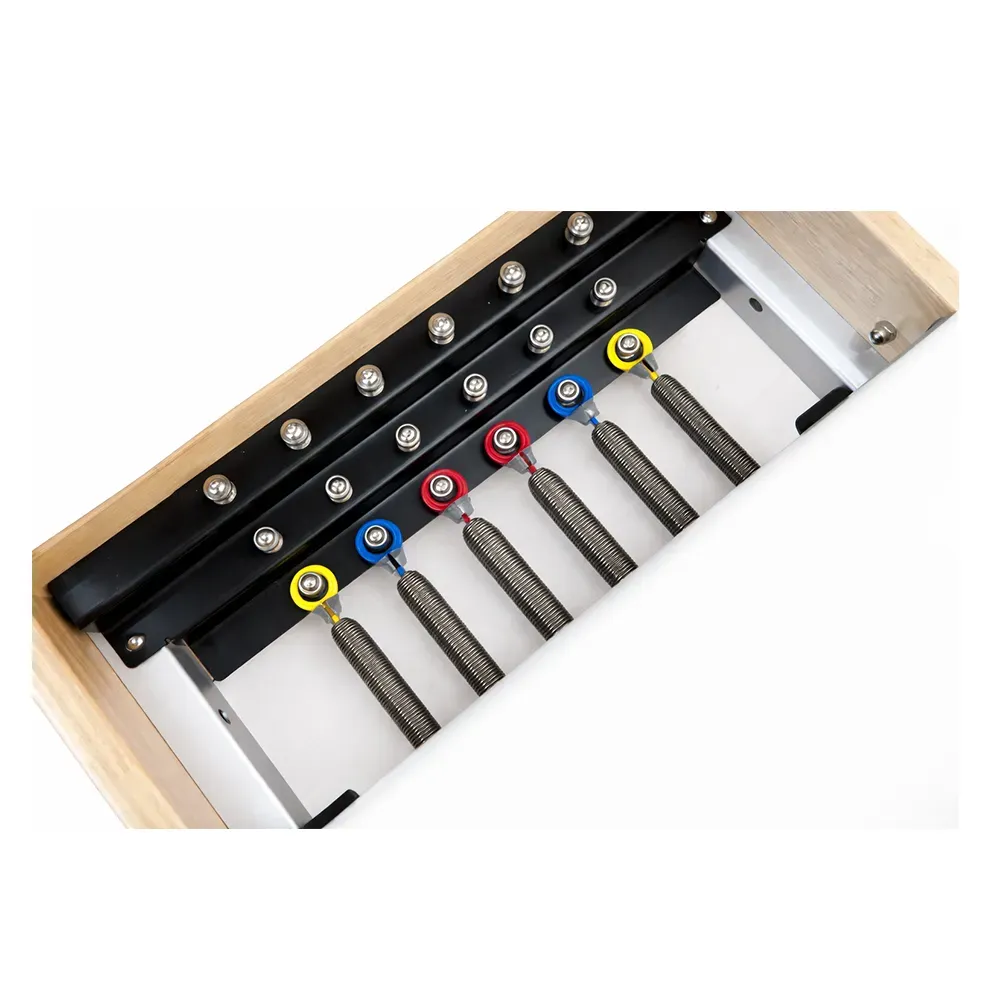
In the world of professional Pilates, the wooden reformer is often celebrated for its aesthetic beauty and structural grounding. However, the "heartbeat" of the machine isn't the wood—it’s the Spring System.
While the frame provides the stage, the springs provide the soul of the movement. At Leyue, we understand that spring tension accuracy is not just a feature; it is a fundamental requirement for safety, progression, and kinetic integrity.
1. The Physics of Resistance: Beyond Simple Tension
Unlike gym weight stacks that rely on gravity, Pilates springs operate on the principle of Progressive Resistance. This follows Hooke’s Law (F = kx), where the force increases as the spring extends.
Understanding resistance is key to mastery. For more on how we build these machines, read our Quality Pilates Reformer Manufacturing Guide
- Eccentric Control: Springs challenge the muscle during both the extension and the return phase, which is vital for building long, lean muscle mass.
- Variable Loading: The resistance is lightest at the start of the movement and heaviest at the peak of the contraction, mimicking natural human muscular force curves.
2. Why Precision Engineering Matters for Wood Frames
In a wooden reformer, the spring system is anchored directly into the chassis. This creates a unique relationship between the "living" material of the wood and the "reactive" material of the steel.
The Leyue Manufacturing Edge:
- CNC-Aligned Anchor Points: We use advanced CNC machining to ensure that spring hooks are positioned with sub-millimeter accuracy. Even a 2mm deviation can cause the carriage to pull unevenly, leading to long-term wear on the wood frame and joint instability.
- Zero-Noise Integration: Our anchor holes are precision-drilled to prevent the metal-on-wood "creaking" often found in lower-quality machines.
3. The Color-Coded Spectrum: Customizing the Workout
A professional Leyue reformer utilizes a tiered spring system to accommodate everyone from rehabilitation patients to elite athletes.
Resistance Level | Typical Use Case | Benefit |
Yellow (Light) | Arm work, Core stability | Challenges balance and deep stabilizer muscles. |
Green (Medium) | Standard Leg work | Provides steady support for fundamental movements. |
Red (Heavy) | Powerful lower body | Builds explosive strength and high-intensity resistance. |
4. The Hidden Danger of Tension Decay
Over time, inferior springs lose their "memory," meaning the $k$ value in Hooke’s Law decreases. This leads to:
- Imbalanced Training: If the left spring is weaker than the right, the practitioner will develop muscular asymmetries.
- Safety Risks: Springs that have been over-stretched or poorly manufactured are prone to sudden snapping.
At Leyue, we use music-grade steel with high fatigue resistance, ensuring that our tension remains accurate even after years of commercial studio use.
Conclusion: Investing in Accuracy
When you choose a Leyue wooden reformer, you are investing in the perfect marriage of organic stability and mechanical precision. By prioritizing spring tension accuracy, we ensure that every session in your studio is safe, effective, and silent.
Accuracy declines without care. Keep your springs in top shape with our Pilates Reformer Maintenance Guide.
Related Professional Guides
- Maintenance: [Pilates Reformer Maintenance: An Expert's Longevity Guide]
- Engineering: [What Makes a Quality Pilates Reformer? A Manufacturing Guide]