
Sep 30, 2026Product Knowledge & Guides
Wooden Foldable Pilates Reformer Wholesale: A B2B Buying Guide
Source wooden foldable Pilates Reformers wholesale. Compare frame materials, folding mechanisms, springs, packaging, OEM options and supplier quality control.
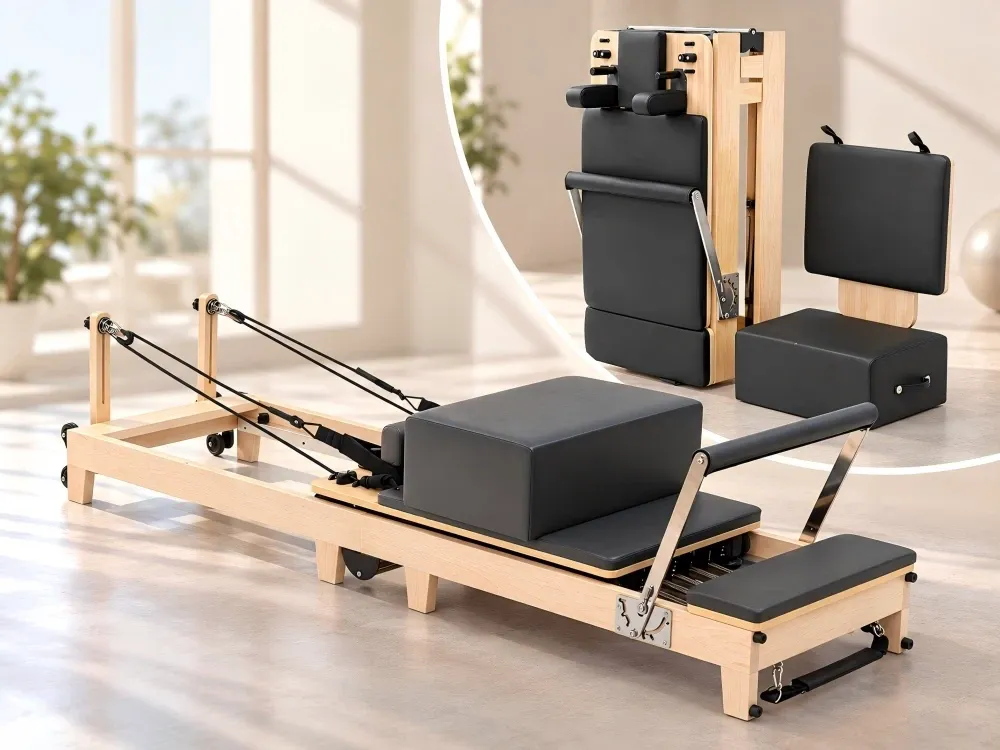
For Pilates equipment distributors, importers and private-label fitness brands, wooden foldable Reformers represent an interesting opportunity to combine professional equipment design with space-saving functionality.
Purchasing requirements can vary significantly. Some buyers begin with a small trial order, while established distribution businesses may plan purchases involving hundreds or thousands of units, sometimes reaching five-figure annual volumes.
At this scale, selecting a suitable manufacturer is no longer simply about finding an attractive product at a competitive FOB price.
Buyers must also consider manufacturing consistency, component sourcing, production scheduling, packaging efficiency, OEM customization and long-term after-sales support.
A folding Reformer introduces additional technical considerations because its frame, hinges, locking mechanism and rail system must function together after repeated folding and unfolding.
This guide explains what international wholesale buyers should evaluate before placing a bulk order for wooden foldable Pilates Reformers.
1. Why Wooden Foldable Reformers Deserve Attention in Wholesale Product Planning
For distributors building their Pilates equipment collections, foldable Reformers offer a distinct product category alongside traditional wooden and aluminum models.
Their main selling point is the ability to reduce storage requirements when the equipment is not being used.
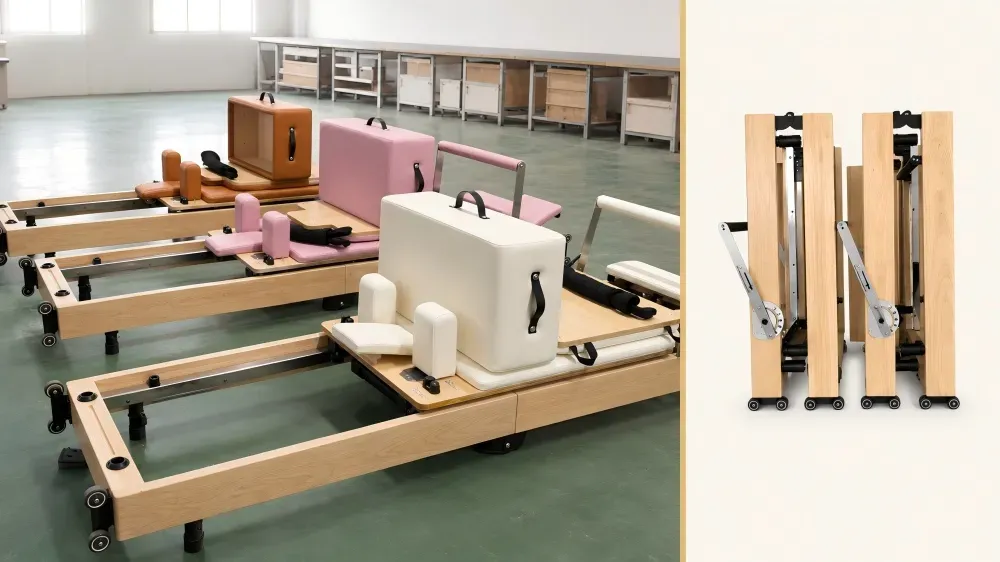
This can appeal to several customer segments:
- Home fitness equipment retailers.
- Online Pilates equipment brands.
- Boutique Pilates studios with limited floor space.
- Multi-purpose fitness and wellness facilities.
- Regional distributors offering different Reformer configurations.
For wholesale buyers, however, product positioning should be defined before selecting a model.
A competitively priced home-use Reformer and a professional-grade folding Reformer may have different structural specifications, accessories and manufacturing costs.
Rather than sourcing based on appearance alone, distributors should establish the intended market, expected retail price, product configuration and after-sales requirements.
Explore the Leyue Wooden Pilates Reformer Collection to compare different wooden equipment configurations.
2. Choosing the Right Wooden Foldable Reformer Configuration
One of the first decisions in a bulk sourcing project is selecting the correct frame material and product structure.
Different markets may prefer different wood finishes, frame profiles, upholstery colors and accessory packages.
Solid Thai Oak Foldable Reformer
The Leyue Solid Thai Oak Foldable Pilates Reformer features a solid Thai Oak frame, a folding structure and a compact storage design.
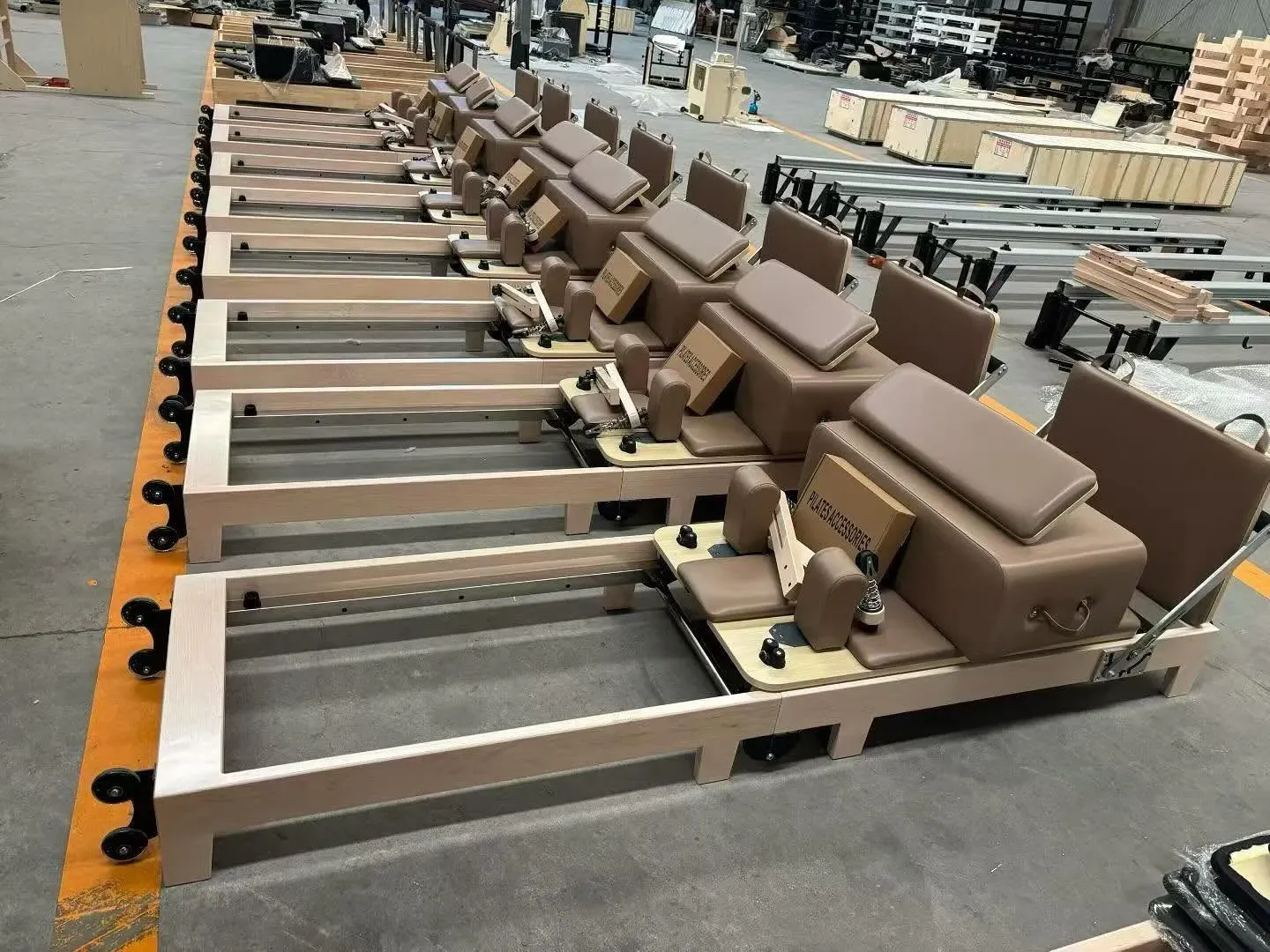
Its published specifications include:
Specification | Configuration |
|---|---|
Frame | Solid Thai Oak |
Springs | 5 Korean KOS steel wire springs |
Wheels | Silent PU wheels |
Upholstery | Microfiber leather |
Folded dimensions | 1265 × 700 × 580 mm |
OEM service | Available |
This configuration provides an option for distributors looking for natural wooden aesthetics and compact storage functionality.
Folding Wooden Reformer Series
Available options include Oak, Beechwood and Maple, together with Grounded and Elevated leg configurations.
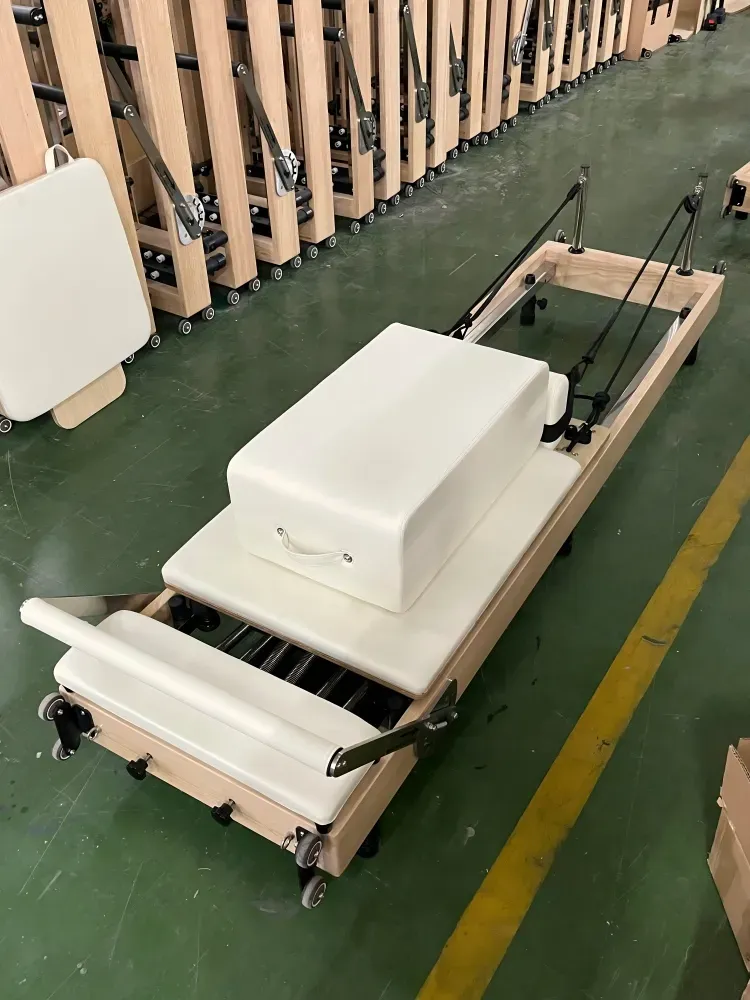
This allows buyers to evaluate different product appearances and storage requirements according to their target market.
For large-volume orders, the exact spring system, accessory package, upholstery and final specifications should be confirmed against the selected model's quotation and technical sheet.
Wholesale purchasing tip: Select one approved reference configuration before requesting quotations for multiple quantities. This makes pricing and production comparisons more meaningful.
Also Considering Aluminum Foldable Reformers?
Wooden and aluminum foldable Reformers serve different product positioning and purchasing requirements.

For distributors evaluating both materials, we recommend comparing frame construction, folding mechanisms, product weight, customization options and target retail pricing before selecting a model.
3. Frame Materials, Springs, Pulleys and Upholstery
Two wooden foldable Reformers can look similar in photographs while using different materials and component specifications.
For distributors planning repeat orders, these differences can influence purchasing costs, maintenance requirements and product consistency.
Wooden Frame Construction
Confirm the actual wood species and frame construction.
A natural wood finish does not necessarily mean that every structural component is manufactured from solid wood.
Buyers should request clear information about the material, frame connections and manufacturing process.
Spring System
The spring configuration should be specified by quantity, material, resistance level and replacement compatibility.
For large-volume projects, consistent resistance specifications across production batches are particularly important.
Carriage and Pulley System
Evaluate the carriage wheel material, rail construction, pulley system and rope adjustment mechanism.
A sample inspection should include movement across the full working range rather than focusing only on the external appearance.
Upholstery and Foam
Confirm the upholstery material, foam construction, stitching and available color options.
For private-label programmes, approved upholstery samples can help establish a consistent visual standard for repeat orders.
Accessories
The quotation should identify all included accessories, such as the Jumpboard, Sitting Box, Standing Platform, ropes and straps, according to the selected configuration.
For bulk purchasing, the accessory list should be included in the approved specification sheet and final packing list.
4. Folding Mechanism and Rail Alignment: Critical Points for Bulk Buyers
The folding mechanism is one of the most important areas to evaluate when purchasing folding Pilates equipment.
Unlike a fixed-frame Reformer, a folding model contains additional connecting components that must maintain the correct position during use.
Important inspection points include:
- Folding hinge construction.
- Frame locking mechanism.
- Rail alignment after unfolding.
- Carriage movement across the folding connection.
- Repeated folding and unfolding.
- Stability after the frame is fully opened and locked.
For a large-volume order, these checks should be incorporated into a repeatable inspection procedure rather than relying on the performance of a single showroom sample.
Buyers should also request a video showing the actual production model being folded, unfolded and operated.
We have discussed carriage movement and folding-joint alignment in greater detail in our existing article:
This is particularly useful for buyers evaluating the relationship between frame positioning, rail alignment and carriage movement.
5. OEM & Private Label Manufacturing for Pilates Equipment Brands
For distributors building their own product lines, OEM manufacturing can help establish a consistent brand identity across different markets.
Common customization requirements include:
OEM Option | Details to Confirm |
|---|---|
Frame material | Available wood species and construction |
Upholstery | Standard or custom color options |
Logo | Engraving, printing or other available methods |
Accessories | Selected standard or customized package |
Packaging | Neutral or branded export cartons |
Instructions | Language and branding requirements |
Spare parts | Replacement components and identification |
For large-volume projects, all customization details should be approved before mass production.
Why Approved Samples Matter
An approved production sample provides a reference for material selection, color, construction and accessories.
When an order involves multiple production batches, the same approved specifications should be used throughout the manufacturing programme.
For upholstery and accessories, buyers should also consider that different materials and production batches may show slight color variations.
Where precise color coordination is important, physical sample approval is preferable to relying exclusively on digital photographs.
Structural Customization
Changing the frame dimensions, folding mechanism or rail structure requires additional technical evaluation.
Such modifications may affect manufacturing cost, production time and testing requirements.
For new private-label projects, beginning with an established product configuration and customizing the appearance may simplify the initial purchasing process.
6. Planning Large-Volume Orders: From Hundreds to Thousands of Reformers
Large-scale purchasing requires a different approach from a small trial order.
A distributor planning to purchase 100 units may primarily focus on sample approval, price and delivery time.
A buyer planning 1,000, 3,000 or more units must also evaluate material availability, production scheduling, manufacturing consistency and shipping arrangements.
For annual purchasing programmes involving several thousand or even 10,000 units, production planning becomes especially important.
What Should You Discuss with the Manufacturer?
Before confirming a large-volume project, request information about:
- Production capacity for the selected model.
- Availability of wood and major components.
- Material purchasing arrangements.
- Expected production lead time.
- Production scheduling for repeat orders.
- Quality inspection procedures.
- Packaging and warehouse arrangements.
- Options for phased delivery.
Actual manufacturing capacity should be confirmed for the selected configuration and delivery period.
Single Shipment vs Phased Delivery
Not every distributor wants to receive the entire annual order in one shipment.
For example, a buyer planning 3,000 units may prefer to arrange several shipments according to warehouse capacity and regional sales requirements.
A phased delivery programme can help coordinate production, inventory and transportation.
However, the schedule should be agreed upon before production begins, especially when customized materials or packaging are required.
Establishing a Repeat-Order Programme
For long-term wholesale relationships, buyers should consider sharing their estimated annual purchasing plan.
This helps both parties discuss material planning, product consistency, packaging requirements and future production arrangements.
A clear purchasing forecast is particularly valuable when the same product will be distributed across multiple markets or sales channels.
7. Packaging, Container Loading and International Shipping
For large-volume importers, packaging efficiency can significantly affect the total landed cost.
The product's FOB price is only one part of the purchasing calculation.
Export carton dimensions, gross weight, container loading quantity, handling requirements and local delivery costs should also be considered.
Folded Dimensions vs Packed Dimensions
A folding Reformer may occupy less storage space after folding, but its actual shipping volume depends on the final export packaging.
For example, the Solid Thai Oak Foldable Reformer has published folded dimensions of 1265 × 700 × 580 mm.
These are product dimensions, not confirmed shipping carton dimensions.
Container loading calculations should always use the approved packaging specifications.
Packaging Information to Request
Information | Why It Matters |
|---|---|
Export carton dimensions | Determines shipping volume |
Net and gross weight | Supports freight and handling calculations |
Packaging materials | Protects equipment during transportation |
Cartons per unit | Supports warehouse and delivery management |
Container loading quantity | Helps estimate freight allocation |
Accessories packing list | Reduces missing-component issues |
Carton labels | Supports inventory identification |
For distributors selling through online marketplaces, packaging should also be evaluated against their domestic delivery requirements.
Container Loading Efficiency
When purchasing hundreds or thousands of Reformers, even a relatively small difference in packaging volume can affect container utilization.
Buyers should request loading estimates for the selected product configuration and packaging design.
Theoretical CBM calculations should not be treated as guaranteed loading quantities because actual container loading depends on carton dimensions, stacking limitations, handling space and other shipping conditions.
8. Quality Control Across Multiple Production Batches
A successful sample inspection is only the beginning of a large-volume purchasing project.
For repeat orders, consistency between production batches is equally important.
Wholesale buyers should establish clear inspection requirements covering the frame, mechanical components, appearance, accessories and packaging.
Recommended Quality Control Checklist
Inspection Area | Main Checks |
|---|---|
Wooden frame | Material, dimensions, finish and assembly |
Folding structure | Hinge operation and locking mechanism |
Rail system | Alignment and carriage movement |
Springs | Quantity, configuration and installation |
Pulley system | Operation and component assembly |
Upholstery | Color, stitching and surface condition |
Accessories | Quantity and compatibility |
Packaging | Protection, labeling and packing list |
For larger orders, buyers may also consider production-stage inspections and pre-shipment inspections according to their purchasing agreements.
Testing Documentation
Importers should request the relevant test reports and supporting documentation for their intended market.
Leyue Pilates presents EN ISO 20957 Class S and SGS-related credentials on its website. Buyers should confirm the applicable standard edition, scope and exact model coverage before relying on a document for import or product compliance purposes.
Customization involving structural changes may require additional verification.
Warranty and Replacement Parts
For distributors selling hundreds or thousands of units, after-sales arrangements should be established before shipment.
Confirm warranty coverage for the frame and components, as well as the process for handling manufacturing defects, transit damage and replacement parts.
A defined spare-parts programme can help distributors manage after-sales service more efficiently.
9. Wholesale Pricing: Why Annual Volume Matters
For bulk Pilates equipment sourcing, price should be evaluated against a clearly defined product configuration.
A lower unit price does not necessarily mean that two quotations represent equivalent equipment.
Differences in wood material, folding structure, springs, pulleys, upholstery, accessories and packaging can all influence manufacturing costs.
Information to Include in a Bulk RFQ
Purchasing Requirement | Information to Provide |
|---|---|
Selected model | Product name or reference image |
Initial order quantity | Estimated first-order volume |
Annual purchasing volume | Expected total requirement |
Frame material | Preferred wood and construction |
Components | Springs, wheels, pulleys and accessories |
OEM requirements | Logo, upholstery and packaging |
Target price | Expected FOB purchasing range |
Destination market | Country and sales channels |
Shipping schedule | Single or phased delivery |
After-sales requirements | Warranty and spare parts |
For distributors evaluating 500, 1,000, 3,000 or more units, sharing the estimated annual purchasing plan helps manufacturers evaluate appropriate production and quotation arrangements.
These quantities are examples of potential purchasing scenarios, not fixed minimum order quantities or guaranteed pricing tiers.
Consider Total Landed Cost
When comparing suppliers, include:
Product cost + packaging + international freight + applicable import charges + domestic distribution + after-sales expenses.
For large-volume buyers, optimizing the complete purchasing programme can be more useful than negotiating the unit price in isolation.
10. Why Work with Leyue Pilates?
Leyue Pilates is a Chinese Pilates equipment manufacturer established in 2007, with approximately 20 years of manufacturing experience in wooden and aluminum Pilates equipment.
We provide OEM and ODM services for international equipment distributors, private-label brands and Pilates businesses.
Our product collection includes wooden Reformers, aluminum Reformers, folding models, Towers, Cadillacs, Chairs and related accessories.
For buyers developing a wooden folding Reformer product line, we can discuss available configurations, material choices, customization requirements, packaging and wholesale quotations.
Explore our product range:
A solid-wood folding configuration with compact storage functionality.
Explore different wooden frame materials and leg configurations.
Compare our wider range of wooden Reformer designs.
For buyers still comparing frame materials, our existing article, Aluminum vs Wooden Foldable Pilates Reformer, provides additional information on material selection, handling, maintenance and product positioning.
11. Request a Bulk Wooden Foldable Reformer Quotation
Planning a Wholesale Order or OEM Manufacturing Programme?
Whether you are preparing an initial product launch or developing a larger distribution programme involving hundreds or thousands of Reformers, Leyue Pilates welcomes international wholesale enquiries.
To help us prepare a suitable proposal, please share your preferred product model, estimated initial order quantity, annual purchasing plan, customization requirements and destination country.
Our team can provide available product specifications, OEM options, packaging information and FOB quotations based on your requirements.
Contact Leyue Pilates to discuss your next wooden foldable Reformer sourcing project.
Leyue Pilates | OEM & ODM Pilates Equipment Manufacturer