
Aug 18, 2026Product Knowledge & Guides
Foldable Pilates Reformer Carriage Bump: Buyer Guide
Will a foldable Pilates reformer feel bumpy? Learn what affects carriage smoothness and what studios and distributors should test before ordering.

Will a Foldable Pilates Reformer Feel Bumpy? What Buyers Should Check
Foldable Pilates reformers offer a practical solution for home users, Pilates studios and fitness equipment distributors looking to reduce storage requirements without giving up the functionality of a full-size reformer.
However, buyers frequently ask one important question:
Will the carriage create a noticeable bump or hesitation when it passes the folding area?
This concern is understandable. A reformer relies on continuous, controlled carriage movement. Even a small interruption can affect how the exercise feels, particularly during slow and precise Pilates movements.
The short answer is that a folding joint does not automatically mean that the carriage will feel bumpy. The actual experience depends on the folding structure, frame positioning, rail alignment, carriage wheel system and assembly consistency.
In this guide, we explain what buyers should check and how to evaluate carriage movement before approving a sample or placing a bulk order.
If you are currently comparing different models, you may also want to read our guide to the most common mistakes when buying a foldable Pilates reformer.
Does a Folding Joint Always Cause a Carriage Bump?
Not necessarily.
A well-designed folding structure should allow the reformer frame to return to a stable and consistent working position after it has been unfolded and locked.
When the two frame sections are correctly positioned, the rail system remains aligned and the carriage wheels maintain even contact, the carriage should travel through its working range without an obvious stop, lift or sideways movement.
It is also important to distinguish between two different experiences:
- A slight change in sound as the carriage moves
- A noticeable physical interruption in the movement
A small change in sound does not always mean that the carriage is experiencing a bump. Buyers should focus on whether the carriage visibly slows down, lifts, shifts sideways or requires additional force to continue moving.
The best way to make this assessment is by observing an actual product test rather than relying only on a supplier’s written description.
Full carriage travel and product details on an actual foldable wooden Pilates reformer.
The video above shows an actual production unit rather than a rendered product concept. When reviewing a test video, pay attention to whether the carriage maintains continuous movement throughout its working range.
What Determines Smooth Carriage Movement?
Several parts of a foldable reformer work together to create a smooth and controlled carriage experience.
1. Accurate Frame Positioning After Unfolding
A foldable reformer is made of frame sections connected by a folding mechanism. After the reformer is opened, these sections must return to the correct working position.
If the frame is not fully unfolded or the locking structure is not correctly engaged, the two sections may not remain properly aligned.
For this reason, buyers should check:
- Whether the frame opens completely
- Whether the locking components are easy to operate
- Whether the frame remains stable after locking
- Whether the same position can be achieved after repeated folding and unfolding
The folding mechanism should provide both convenient storage and reliable positioning during use.
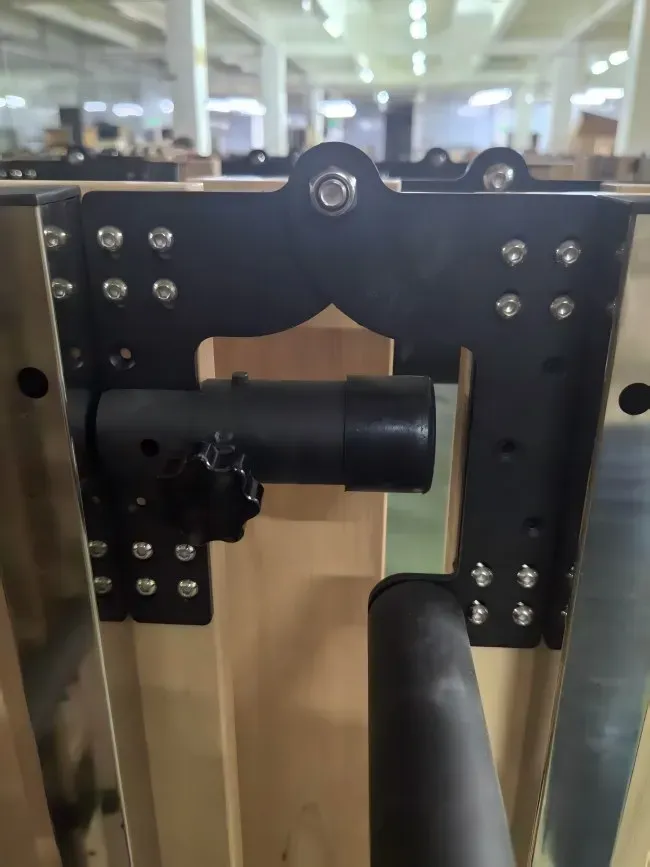
Reinforced folding connection used to maintain frame positioning after the reformer is unfolded.
2. Rail and Carriage Alignment
The carriage travels along the reformer’s rail system. On a folding model, buyers should evaluate the alignment of the complete travel path after the frame is opened.
It is not enough to look only at the visible size of the joint. The most important question is how the fully assembled reformer performs.
During testing, observe whether:
- The carriage travels in a straight line
- The wheels maintain even contact with the rail
- The carriage remains level
- There is an obvious pause at any point
- The carriage moves sideways as it passes the folding area
- Additional force is required to continue the movement
A visual inspection should always be combined with an actual carriage test.
3. Carriage Wheel System
The carriage wheel system affects smoothness, stability and noise.
Wheel positioning, material, bearings and load distribution all contribute to the final movement experience. Even when the frame structure is properly aligned, an inconsistent wheel system can cause uneven movement.
The carriage should therefore be checked at both slow and normal operating speeds.
Slow movement makes it easier to notice small changes in resistance, while normal movement better represents the experience during an actual Pilates session.
4. Assembly and Production Consistency
A smooth sample does not automatically guarantee that every unit in a bulk order will perform in exactly the same way.
For distributors, private-label brands and multi-unit studio projects, production consistency is just as important as the quality of the original sample.
Important considerations include:
- Consistent installation of folding components
- Correct tightening of structural hardware
- Alignment of the frame and rail system
- Carriage wheel installation
- Final movement inspection before packing
This is why buyers should ask how the supplier checks production units—not only how the original sample was tested.
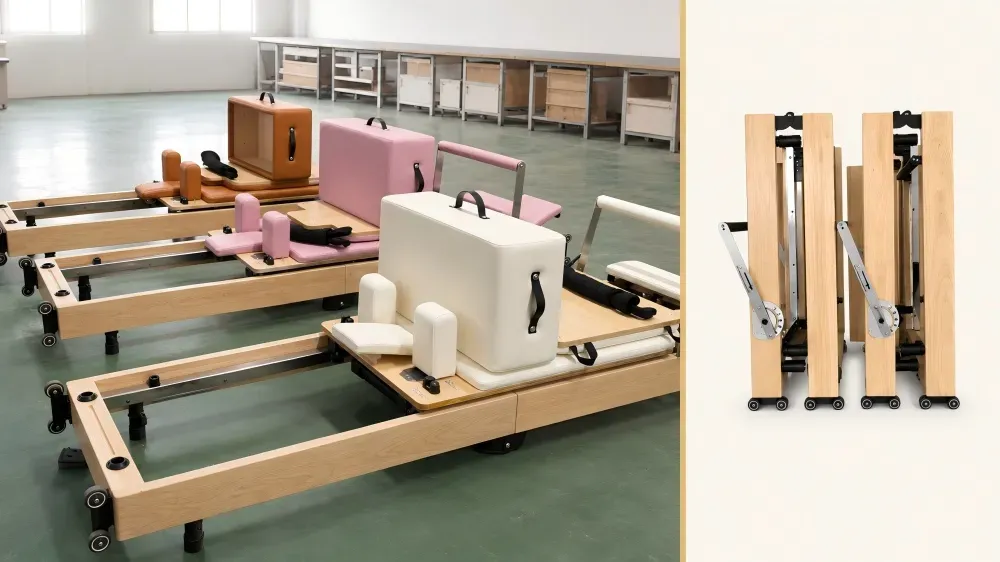
Multiple foldable reformers prepared during batch production, showing the compact folded structure and production consistency.
How Should Buyers Test a Foldable Pilates Reformer?
Before placing a large order, buyers should request a clear and preferably unedited testing video.
The following procedure provides a practical way to evaluate the equipment.
Step 1: Fully Open and Lock the Frame
The supplier should show how the reformer is unfolded and how the frame is secured in its working position.
This confirms that the carriage test is being performed with the folding structure correctly installed.
Step 2: Test the Carriage Slowly
Move the carriage through its full travel range at a slow speed.
A slow test makes it easier to observe small interruptions, vertical movement or changes in resistance.
Step 3: Repeat at Normal Exercise Speed
The carriage should also be moved at a speed that represents normal training.
The transition should remain controlled without an obvious stop or sudden directional change.
Step 4: Test With a Spring Connected
An unloaded carriage test is useful, but it should not be the only test.
Connecting a spring allows the buyer to observe the carriage under resistance and better represents normal reformer operation.
Step 5: Fold and Reopen the Reformer
The reformer should be folded, reopened and tested again.
This helps demonstrate whether the frame returns to a consistent operating position after the folding mechanism has been used.
Step 6: Request Testing Under Actual User Load
If possible, ask the supplier to provide an additional video with a person using the carriage.
A loaded test allows buyers to evaluate movement under more realistic conditions.
Step 7: Confirm Bulk-Order Inspection
For a bulk order, ask whether the supplier tests production units before packing.
A sample test proves the performance of one machine. Production inspection helps confirm consistency across the complete order.
Foldable Reformer Buyer Checklist
What to Check | What Buyers Should Look For |
|---|---|
Folding mechanism | Easy operation and secure positioning |
Frame alignment | Both frame sections remain level after unfolding |
Carriage travel | Continuous movement without an obvious stop |
Wheel contact | Wheels remain evenly positioned on the rail |
Slow-speed test | No visible lift, hesitation or sideways movement |
Spring-connected test | Controlled movement under resistance |
Repeatability | Similar performance after folding and reopening |
Batch inspection | Production units are checked before packing |
Spare parts | Replacement wheels, bearings and hardware are available |
Why Carriage Smoothness Matters for Studios and Distributors
For a home user, an uneven carriage can reduce comfort and affect the overall training experience.
For a Pilates studio, the consequences may be more significant. Clients and instructors use the equipment repeatedly and are more likely to notice differences between machines.
Inconsistent carriage movement may lead to:
- Client complaints
- Differences in training experience between machines
- Increased maintenance requirements
- Additional after-sales communication
- Replacement-part costs
- Returns or negative product reviews
For distributors and private-label brands, the cost of after-sales support can quickly become more important than a small difference in the original purchase price.
This is why carriage movement should be evaluated before the buyer compares only appearance, accessories or unit price.
Compact Storage Should Not Mean Ignoring Performance
The main advantage of a foldable Pilates reformer is clear: it provides a full-size working platform while requiring less storage space when not in use.
This makes it especially practical for:
- Home Pilates users
- Apartments and limited spaces
- Multi-purpose fitness rooms
- Small private studios
- Mobile instructors
- Equipment distributors with limited warehouse space
- Online retailers selling space-saving fitness equipment
The folded structure also allows multiple reformers to be stored in a relatively compact area.
Folded wooden reformers stored during batch production.
However, storage convenience should not be evaluated separately from training performance.
A foldable reformer should solve a space problem without creating a new movement problem. Buyers should therefore consider three factors together:
- Compact folded dimensions
- Stable positioning after unfolding
- Consistent carriage movement during use
The right balance between these factors is more important than the folding feature alone.
Actual Production Materials, Not Only Product Renderings
The images and videos in this article come from actual production units.
They show:
- The complete reformer in its working position
- The compact folded configuration
- The folding connection and locking components
- Carriage movement with spring resistance
- Multiple units during batch production
- Equipment during factory assembly
Real production materials help buyers understand how a product is constructed and how it performs beyond catalogue photographs.
At Leyue Pilates, we support studios, distributors and private-label brands with product videos, factory inspection materials and customization information before order confirmation.
You can view more details about our solid Thai oak foldable Pilates reformer, including its folded configuration, accessories and wholesale options.
Frequently Asked Questions
Is a slight change in sound the same as a carriage bump?
No. A change in sound does not necessarily mean that the carriage movement is being interrupted. Buyers should observe whether the carriage slows down, lifts, shifts or requires additional force.
Does a visible folding joint automatically indicate poor quality?
No. The appearance of the joint alone does not determine the final performance. Frame positioning, rail alignment, wheel configuration and actual carriage movement should be evaluated together.
Can a foldable Pilates reformer be used in a studio?
It depends on the product design, frequency of use and the studio’s requirements. Foldable reformers can be practical for private studios and multi-purpose spaces, but buyers should verify stability, carriage performance and the intended usage classification of the specific model.
Should I test only the sample?
No. Sample approval is the first step, but bulk buyers should also confirm how production units are inspected before packing.
What video should I request from a supplier?
Ask for an unedited video showing the frame being unfolded and locked, followed by slow and normal-speed carriage movement through the full travel range. A spring-connected and user-loaded test provides additional useful evidence.
Final Thoughts
A foldable Pilates reformer should not be judged only by how compact it becomes when stored.
Buyers should evaluate the complete movement system, including the folding connection, frame positioning, rail alignment, carriage wheels and actual travel performance.
A folding joint does not automatically mean that the carriage will produce a noticeable bump. What matters is how the equipment is designed, assembled, tested and reproduced across a bulk order.
Before choosing a supplier, request actual production videos, observe the full carriage travel and confirm how the factory controls consistency.
Looking for a foldable reformer for your studio, distribution business or private-label product line?
Contact Leyue Pilates to request product specifications, a full carriage test video or a wholesale quotation.