
Jun 26, 2026Product Knowledge & Guides
Pilates Reformer Noise & Rust: Hidden Cost You Ignore
Is your reformer getting noisy or rusty? Discover the hidden hardware problem that increases maintenance costs and affects client experience in Pilates studios.
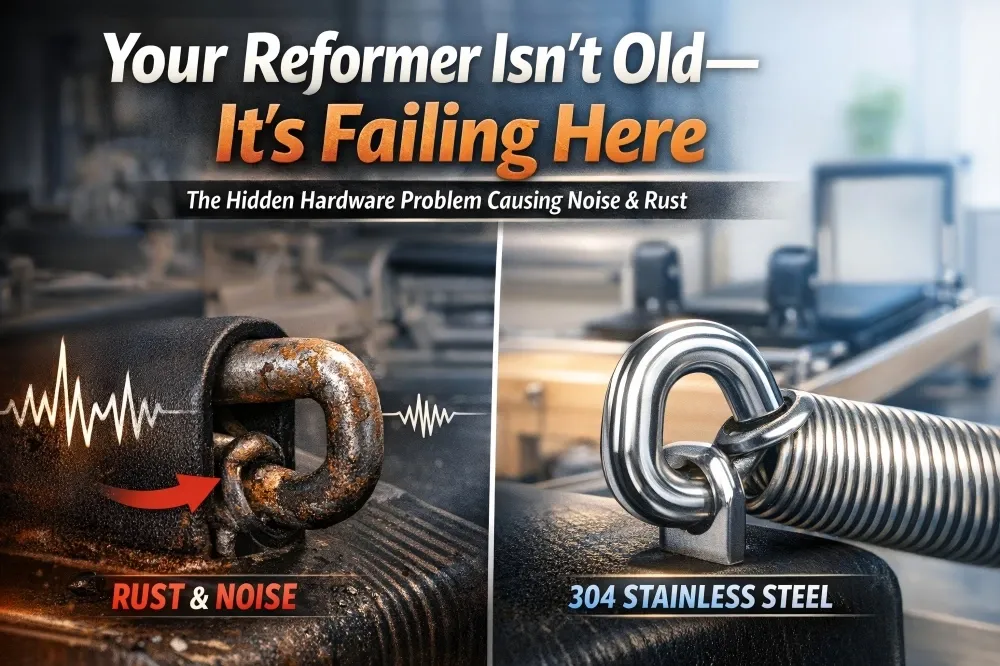
Is Your Pilates Reformer Aging Faster Than It Should?
The Hidden Hardware Problem Behind Noise, Rust, and High Maintenance Costs
When studio owners invest in Pilates equipment, most of the attention goes to what clients can see.
The natural wood frame.
The smooth leather upholstery.
The overall aesthetic that defines the studio’s brand.
These elements matter, especially for first impressions.
But after months of real use—especially in busy studios—it’s not the visible parts that determine performance.
It’s the hardware.
And by the time hardware starts to fail, it’s already affecting your:
- Client experience
- Maintenance costs
- Brand perception
The First Sign: A Sound That Shouldn’t Be There
At the beginning, everything feels perfect.
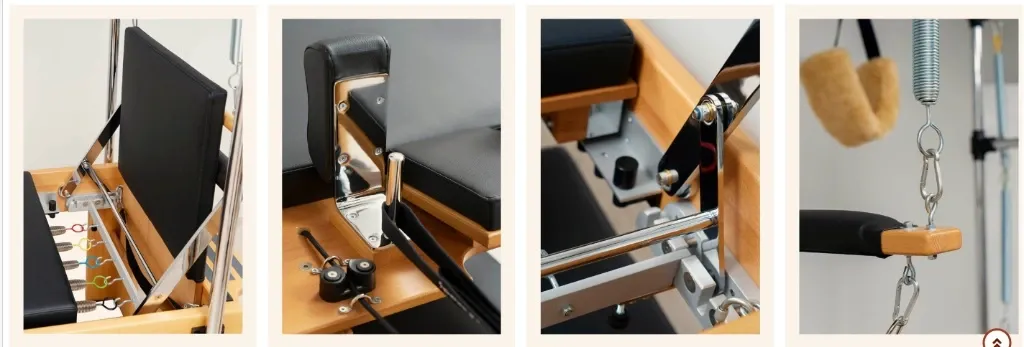
“At first glance, most reformer hardware looks polished and professional.
But what you’re actually seeing is often a plated surface—not the real material underneath.”
The carriage glides smoothly.
The springs respond precisely.
The entire system feels controlled and quiet.
Then gradually, something changes.
A slight squeak appears.
A faint metal friction sound during spring changes.
At first, it’s easy to ignore.
But over time, it becomes noticeable—especially in a quiet studio environment where every sound matters.
Pilates is built around:
- Control
- Precision
- Focus
Noise breaks that experience instantly.
For high-end studios, this is not a small issue.
It directly impacts how clients perceive quality.
Why Do Pilates Reformers Become Noisy?
Many studio owners assume all reformers perform the same, but the difference between entry-level machines and commercial Pilates equipment becomes obvious after months of high-frequency use.
The most common cause is not poor design.
It’s material choice.
Many reformers on the market use electroplated iron hardware for components such as:
- Spring hooks
- Connectors
- Small structural parts
These components look polished and high-quality when new.
But the performance of plated materials depends entirely on one thing:
The integrity of the surface layer.
The “Plating Trap” Explained
Electroplating creates a thin protective coating over iron.
This coating gives:
- A shiny finish
- Initial corrosion resistance
However, it is not permanent.
In a Pilates environment, hardware experiences constant mechanical interaction:
Every time a spring is changed:
- The hook rubs against metal
- Micro-friction occurs
- Tiny scratches form
These scratches are often invisible.
But they are critical.
Because once the plating is damaged, the iron underneath is exposed.
And that’s when the real problem begins.
Sweat + Humidity = Corrosion
Pilates studios are not material-friendly environments.
They involve:
- Repeated physical contact
- High-frequency use
- Exposure to sweat
- Air humidity
Sweat contains salts and moisture, which accelerate corrosion.
Humidity makes oxidation faster.
Once exposed, iron reacts with oxygen and moisture:
Rust begins to form.
This leads to:
- Rough surfaces
- Increased friction
- Irregular mechanical movement
- Squeaking or grinding noise
Why Coastal Studios Face Faster Damage
If your studio is located in coastal or humid regions, the situation becomes more severe.
Examples include:
- California
- Australia
- Mediterranean countries
- Southeast Asia
In these environments, airborne salt significantly accelerates corrosion.
As a result:
- Plated hardware degrades faster
- Rust appears earlier
- Equipment lifespan shortens
What should last years may begin to deteriorate within months under heavy use.
The Second Stage: Peeling and Surface Failure
After corrosion begins, another issue appears.
The plating starts to fail visibly.
It doesn’t fade smoothly.
It peels off in layers.
This creates multiple risks:
1. Safety Concerns
Peeling metal edges can become sharp and cause scratches.
2. Component Damage
Metal flakes can fall into:
- Rails
- Wheels
- Bearings
This accelerates wear on expensive moving parts.
3. Visual Degradation
Even structurally functional equipment starts to look old and poorly maintained.
For studios that position themselves as premium, this is a serious issue.
The Hidden Cost of Low-Quality Hardware
Many buyers focus on initial purchase price.
But hardware quality directly affects long-term cost.
Here’s what typically happens with lower-grade materials:
Increased Maintenance
Frequent lubrication, cleaning, and inspection.
Part Replacement
Hooks, connectors, and small components need to be replaced regularly.
Operational Disruption
Equipment downtime affects class scheduling.
Client Experience Loss
Noise and instability reduce perceived quality.
Over time, these factors cost far more than the initial savings.
A Better Approach: Material-Driven Design
After years of manufacturing experience, one principle becomes clear:
Durability is not about design alone—it’s about material selection.
High-performance Pilates equipment is built differently.
It prioritizes:
- Long-term stability
- Low maintenance
- Consistent performance
Why 304 Stainless Steel Is the Industry Benchmark
For studio owners looking for long-term reliability, choosing a rust-proof Pilates reformer built with 304 stainless steel is not just an upgrade—it’s a necessity for reducing maintenance and ensuring silent performance.
One of the most important upgrades in professional equipment is the use of 304 stainless steel for hardware.
This material offers a fundamentally different level of performance.
1. Built-In Corrosion Resistance
Unlike plated iron, stainless steel does not rely on a surface coating.
It contains chromium, which forms a self-protective oxide layer.
This layer:
- Prevents rust formation
- Repairs itself when scratched
- Remains stable in humid environments
This makes it ideal for:
- High-use studios
- Coastal locations
- Sweat-heavy training environments
2. Long-Term Silent Operation
Noise is often the result of:
- Rust
- Surface roughness
- Irregular friction
By eliminating corrosion, stainless steel ensures:
- Smooth contact surfaces
- Consistent movement
- Quiet performance over time
For studios focused on premium experience, this is critical.
3. Structural Strength and Reliability
Hardware components carry load and endure repeated stress.
304 stainless steel provides:
- High tensile strength
- Resistance to deformation
- Long fatigue life
This ensures:
- Stable performance
- Reduced failure risk
- Longer service intervals
4. Lower Maintenance Requirements
Switching to stainless steel significantly reduces maintenance needs:
- No rust treatment
- Less frequent replacement
- Reduced inspection requirements
This allows studio owners to focus on operations instead of repairs.
The Role of Anodized Aluminum
In addition to stainless steel, many high-end reformers use anodized aluminum for structural components.
This material provides:
- Lightweight strength
- Corrosion resistance
- Stable surface finish
The anodizing process creates a durable protective layer that:
- Does not peel
- Does not chip
- Maintains its appearance over time
The Ideal Combination
The most reliable equipment combines:
- 304 stainless steel hardware
- Anodized aluminum structural components
This results in equipment that is:
- Quiet
- Durable
- Corrosion-resistant
- Low-maintenance
How to Evaluate Pilates Equipment Before Buying
To avoid long-term issues, ask the right questions:
- Are the hooks made of solid stainless steel or plated iron?
- Are aluminum parts anodized or painted?
- How does the equipment perform after 1–2 years of use?
- Is it designed for commercial or light use?
These details matter more than appearance.
Why This Matters for Studio Growth
Investing in a commercial-grade Pilates reformer ensures your studio can scale without constant repairs or performance issues.
If you are planning to scale your studio or build a long-term brand, equipment decisions should support that goal.
Reliable equipment helps you:
- Maintain consistent service quality
- Reduce unexpected costs
- Improve customer retention
- Strengthen brand reputation
Choosing better materials early creates a more stable business foundation.
Final Insight: The Quiet Advantage
The best Pilates equipment is not the most visually impressive.
It is the most reliable.
It:
- Moves smoothly
- Operates silently
- Requires minimal maintenance
And most importantly, it allows your clients to focus completely on their training experience.
Conclusion
What seems like a small detail—hardware material—has a major impact on:
- Performance
- Longevity
- Cost
- Client satisfaction
Your reformer is not aging faster.
It’s simply built with the wrong materials.
FAQ Section
Q1: Why does my Pilates reformer make noise?
A: Most noise comes from worn or rusted hardware. When plated iron parts develop micro-scratches, moisture causes oxidation, increasing friction and creating squeaking sounds.
Q2: How do I fix a noisy Pilates reformer?
A: Temporary fixes include lubrication and cleaning. However, the long-term solution is upgrading to stainless steel hardware, which prevents rust and reduces friction permanently.
Q3: What is the best material for Pilates equipment hardware?
A: 304 stainless steel is the best choice due to its corrosion resistance, durability, and ability to maintain smooth, silent operation over time.
Q4: Why does Pilates equipment rust?
A: Rust occurs when protective plating is damaged and the iron core is exposed to sweat, humidity, or salt air—common in high-use studios.
Q5: Is stainless steel Pilates equipment worth it?
A: Yes. While the upfront cost is higher, it significantly reduces maintenance, extends lifespan, and improves client experience.
Call to Action
If you are evaluating equipment for your studio or distribution business, take a closer look at what’s beneath the surface.
Because in the long run:
Material choice is not a feature—it’s a business decision.
Tired of noisy, high-maintenance equipment?
Explore our 100% rust-resistant Pilates equipment designed for long-term studio use, built with 304 stainless steel hardware and engineered for professional studios.