
Jun 26, 2026Product Knowledge & Guides
Pilates Equipment FAQ 2026: Wood vs Aluminum Guide
Complete Pilates equipment buying guide for 2026. Learn wood vs aluminum differences, commercial vs home selection, and expert tips for studio owners and distributors.
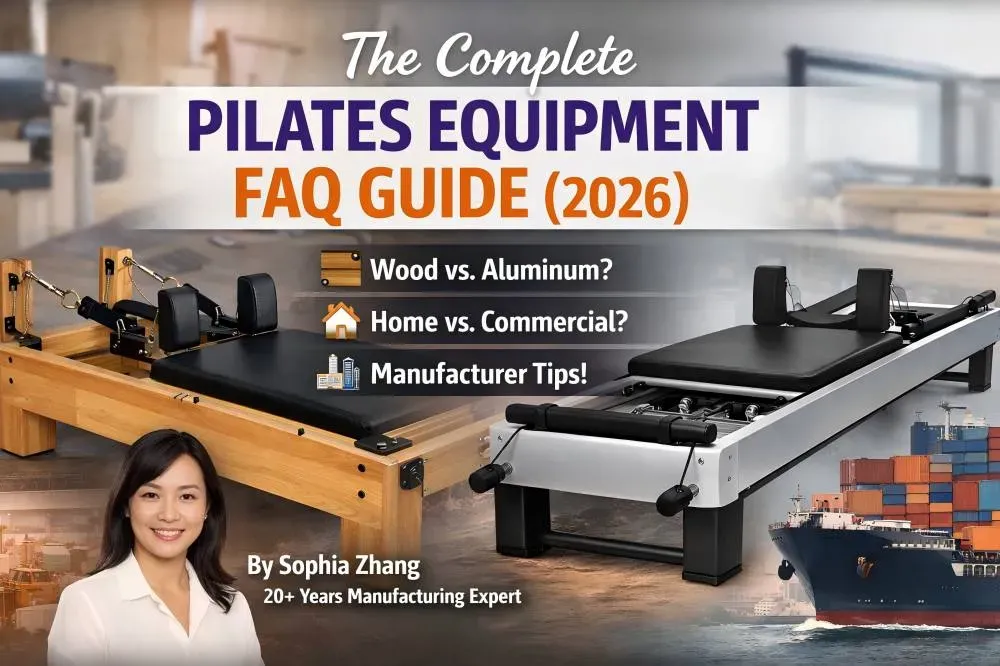
Pilates Equipment FAQ 2026: Wood vs Aluminum Guide
By Sophia Zhang | 20 Years Pilates Equipment Manufacturing Experience
Choosing the right Pilates equipment is not just about buying a machine—it is about making a long-term investment in your business performance, brand positioning, and customer experience.
This guide answers the most important questions from:
- Studio owners
- Wholesalers & distributors
- Private label brands
It is designed to help you avoid costly mistakes and make confident sourcing decisions.
Wood vs Aluminum Pilates Equipment: Key Differences Explained
01. What is the difference between wooden and aluminum Pilates reformers?
Wooden reformers (Maple/Beech) are known for:
- Strong structural stability
- Better shock absorption
- Premium, natural appearance
Aluminum reformers offer:
- Lightweight construction
- Lower cost
- Easier transportation and scalability
👉 In simple terms:
Wood = premium experience
Aluminum = efficiency and cost control
02. Which material is better for commercial use?
Both materials can be used commercially, but their strengths differ:
- Wooden reformers perform better in high-end studios where stability and aesthetics matter
- Aluminum reformers are often used in chains or wholesale distribution due to cost advantages
03. Will wooden reformers crack or deform over time?
Not if properly manufactured.
High-quality factories control wood moisture between 8%–12%, which ensures:
- Stability across different climates
- No cracking in dry environments
- No warping in humid regions
04. Is aluminum strong enough for long-term use?
Yes, when engineered correctly.
Commercial aluminum reformers use:
- Reinforced frames
- Industrial-grade rails
However, they may provide slightly less vibration absorption compared to wood.
Which Pilates Equipment Material Is Better for Long-Term Use?
05. What determines overall durability?
Durability depends on:
- Material quality (wood density or aluminum thickness)
- Precision of assembly
- Component quality (springs, bearings, wheels)
06. How long do springs typically last?
High-quality springs are tested for 100,000+ cycles.
For commercial studios:
👉 Replace every 2 years to maintain safety and resistance accuracy.
07. How quiet should a professional reformer be?
A high-end reformer operates under 20dB.
Noise is influenced by:
- Bearing quality
- Wheel material (POM recommended)
- Rail alignment
08. What ensures a smooth carriage movement?
Smooth movement depends on:
- Multi-wheel system (6–8 wheels)
- Precision rails
- High-quality bearings
👉 Smooth motion directly improves the user experience.
Home vs Commercial Pilates Equipment: What Should You Choose?
09. What is the main difference between home and commercial equipment?
Home equipment:
- Designed for light use (1–2 hours/day)
- Compact and budget-friendly
Commercial equipment:
- Built for heavy use (8–12 hours/day)
- Reinforced structure and components
10. Can home reformers be used in studios?
Not recommended.
Using home equipment in a studio often leads to:
- Faster wear and breakdown
- Safety risks
- Higher long-term costs
11. What is the typical price range?
- Home reformers: $300–$1,500
- Commercial reformers: $2,000–$6,000+
12. How much space is required per reformer?
Recommended:
👉 7 square meters per machine
This ensures:
- Safe movement
- Comfortable training space
- Instructor accessibility
How Studio Owners Should Choose Pilates Equipment
13. What should studio owners prioritize?
Key priorities:
- Smooth and quiet performance
- High-end appearance
- Long-term durability
👉 Equipment directly affects your customer experience and retention.
14. How does equipment influence pricing and branding?
Your equipment defines your positioning:
- Premium machines → premium pricing
- Basic machines → budget perception
15. How important is design and color?
Very important.
Matching equipment with your studio branding:
- Enhances visual identity
- Improves perceived professionalism
How Wholesalers and Distributors Choose Pilates Equipment
16. What matters most for wholesalers?
- Consistent product quality
- Competitive pricing
- Stable supply chain
17. Why is OEM branding important?
OEM allows you to build your own brand through:
- Logo engraving
- Custom colors
- Private label packaging
18. What defines a reliable supplier?
A strong supplier provides:
- Stable production capacity
- Lead times of 15–30 days
- Clear communication
- After-sales support
Packaging, Shipping, and Global Delivery Explained
19. How should Pilates equipment be packaged?
Professional packaging includes:
- 5-layer reinforced cartons
- Honeycomb internal protection
- Optional wooden crates
👉 Proper packaging ensures zero damage during long-distance transport.
20. What shipping options are available?
Common options:
- FOB
- CIF
- DDP (recommended for hassle-free delivery)
21. How long does delivery take?
Typical timelines:
- USA: 25–35 days
- Europe: 30–40 days
- Australia: 20–30 days
22. Can products be mixed in one container?
Yes.
Common mixed orders include:
- Reformer
- Cadillac
- Chair
This helps distributors optimize inventory and reduce costs.
How to Choose a Reliable Pilates Equipment Manufacturer
23. What certifications should a professional Pilates equipment manufacturer have?
At a minimum, a reliable manufacturer must comply with internationally recognized mechanical and structural safety standards. These certifications ensure the equipment is safe for long-term, high-frequency use in professional environments.
1. CE Certification (EN ISO 20957)
This is the mandatory standard for the European market.
- Confirms compliance with EU safety regulations for fitness equipment
- For commercial use, ensure the product meets Class S (Studio/Professional) standards
- Verifies stability, structural integrity, and safe operation under repeated use
👉 Important: Class H (Home Use) is not suitable for studios.
2. ASTM Compliance (e.g., ASTM F2276)
This is the key safety benchmark for the North American market.
- Covers structural strength and load-bearing performance
- Includes fatigue testing under repeated motion cycles
- Requires proper safety labeling and user warnings
👉 Ensures the equipment can withstand long-term commercial usage without failure
3. Other Regional or Equivalent Standards
Depending on your target market, equivalent national standards may apply.
These standards generally verify:
- Resistance to deformation under continuous use
- Mechanical durability of moving components
- Overall operational safety in professional settings
Expert Insight (From a Manufacturer’s Perspective)
Certification is not just a document—it reflects the manufacturer’s engineering capability and quality control system.
When evaluating a supplier, always:
- Request test reports, not just certificates
- Confirm the certification applies to the exact model you are purchasing
- Verify whether testing covers commercial-level usage conditions
Common Mistake to Avoid
Many buyers only check if a product is “CE certified” without verifying:
- Whether it is Class S (commercial) or Class H (home use)
- Whether the certification is valid and product-specific
👉 This can lead to compliance issues and safety risks in real-world use.
24. What are the common sourcing risks?
- Low-quality materials
- Inconsistent production
- Delayed delivery
- Lack of spare parts
25. Why is after-sales support critical?
Because Pilates equipment is a long-term investment.
A good manufacturer provides:
- Spare parts availability
- Technical support
- Maintenance guidance
Frequently Asked Questions About Pilates Equipment
26. What is the ideal maintenance routine?
Clean daily and check components every 6 months.
27. Can upholstery be customized?
Yes, most manufacturers offer multiple color options.
28. Is installation difficult?
Most machines are 90% pre-assembled and easy to set up.
Conclusion
Choosing the right Pilates equipment is not just about price.
It is about:
- Long-term durability
- User experience
- Brand positioning
- Supply chain reliability
👉 The right decision will help you build a strong, sustainable business.
Need Help Choosing the Right Equipment?
We provide:
- Wood & aluminum reformers
- OEM branding solutions
- Global shipping support (DDP available)
Contact us for:
- 2026 catalog
- Wholesale pricing
- Studio setup advice
WhatsApp: +86 13534175495
Website: www.leyuepilates.com