
Sep 2, 2026Product Knowledge & Guides
Why Batch-to-Batch Consistency Matters in Pilates Equipment Manufacturing
Learn why batch-to-batch consistency matters for Pilates studio chains, importers, distributors and private-label brands, and what buyers should check before repeat orders.
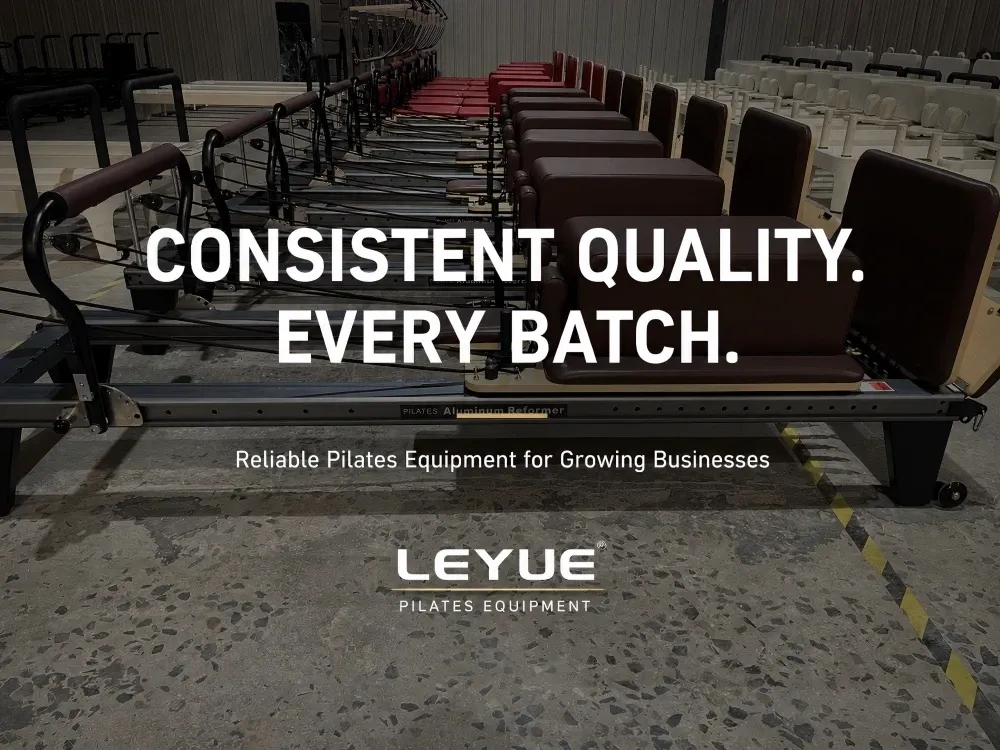
A Pilates equipment order is rarely just about the first shipment.
A studio chain may begin with 10 reformers for its first location, add another 12 machines six months later, and place a larger order when new studios open.
An importer or distributor may reorder the same reformer several times a year. A private-label brand may build an entire product line around one approved model.
In all of these situations, product quality is not only about whether each individual reformer is “good.”
The more important long-term question is:
Will the next production batch match the one that was previously approved?
Frame dimensions, carriage movement, spring resistance, upholstery color, footbar adjustment, accessories, replacement parts and even packaging should remain as consistent as reasonably possible from one production batch to the next.
For studio chains, importers, distributors and private-label Pilates brands, this kind of batch-to-batch consistency directly affects operations, after-sales service, customer experience and long-term purchasing costs.
As the commercial Pilates market expands into studios, gyms, health clubs and multi-location operators, consistency is becoming an increasingly important part of equipment procurement.
For a broader look at this market shift, see our guide to Commercial Reformer Pilates Trends for Gyms & Health Clubs.
What Does Batch-to-Batch Consistency Actually Mean?
Batch consistency does not simply mean that two reformers look similar.
A commercial Pilates reformer contains many structural, mechanical and cosmetic components. Small changes in any of these areas can affect how the equipment looks, feels, performs or is maintained.
For B2B buyers, consistency should be evaluated across several areas.
1. Structural Consistency
Critical structural specifications may include:
- overall frame dimensions;
- rail dimensions and alignment;
- hole positions;
- welding points;
- leg and support structures;
- footbar mounting positions;
- carriage dimensions.
A small dimensional change may appear insignificant during production, but it can create compatibility problems later when replacement components or accessories are required.
2. Performance Consistency
Two reformers can look almost identical but feel noticeably different during exercise.
Performance consistency includes:
- carriage movement;
- wheel resistance;
- bearing performance;
- spring resistance;
- rope length;
- pulley movement;
- footbar adjustment;
- locking mechanisms.
This is especially important for commercial studios where instructors and members use multiple machines during the same class.
If one carriage moves differently from another or spring resistance varies significantly between machines, the inconsistency quickly becomes noticeable.
If you are evaluating equipment for intensive studio use, our Commercial Pilates Reformer Buyer’s Guide explains in more detail how to evaluate frames, carriages, wheels, springs, footbars and other commercial-use components.
3. Material Consistency
Material specifications can also change between production runs if they are not properly controlled.
Important examples include:
- aluminum profiles;
- wood species and grade;
- spring wire;
- wheel and bearing materials;
- upholstery;
- foam density;
- ropes;
- straps;
- fasteners and hardware.
For example, two springs may have the same dimensions and similar appearance but behave differently if the wire specification, heat treatment or manufacturing tolerance changes.
The same applies to wheels, bearings, foam and upholstery.
For repeat B2B orders, the material specification behind the product can be just as important as its appearance.
4. Appearance Consistency
For studio chains and private-label brands, appearance is part of the customer experience.
Important visual details include:
- frame color;
- surface finish;
- wood stain;
- upholstery color;
- stitching;
- logo size;
- logo position;
- accessory colors.
Imagine opening a second studio with another 12 reformers, only to discover that the beige upholstery is visibly warmer than the machines installed at the first location.
Mechanically, there may be nothing wrong with the equipment.
From a branding perspective, however, the difference matters.
5. Accessory Consistency
Accessories are another area where uncontrolled specification changes can create problems.
These may include:
- jump boards;
- sitting boxes;
- shoulder rests;
- platform extenders;
- handles;
- straps;
- ropes;
- springs;
- footbar components.
Maintaining consistent specifications makes future replacement and after-sales service much easier.
Buyers planning long-term equipment programs should therefore consider not only the reformer itself, but also the availability and compatibility of Reformer Accessories and Replacement Parts.
6. Packaging Consistency
Packaging is sometimes overlooked when discussing product consistency, but for importers and distributors it directly affects landed cost.
If the product remains the same but the packing dimensions increase, this can change:
- container loading quantity;
- freight cost per unit;
- warehouse space;
- local handling requirements;
- delivery costs.
For example, a small increase in crate dimensions may reduce the number of reformers that fit into a container.
For an importer ordering dozens of machines, that difference can materially affect the landed cost.
Packaging consistency is therefore also part of commercial product consistency.
Why Studio Chains Need Consistent Equipment Across Locations
Consider a Pilates operator opening three locations:
Location A — 12 reformers
Location B — 12 reformers
Location C — 12 reformers
The equipment may be purchased over 18 months rather than in one order.
If the specifications gradually change between batches, the operator may eventually have three locations using machines with slightly different:
- spring resistance;
- footbar positions;
- carriage movement;
- rope lengths;
- upholstery colors;
- accessories.
For an independent studio, some variation may be manageable.
For a chain, it becomes an operational issue.
Instructors may work across different locations. Training programs may be standardized. Members may attend classes at more than one branch.
The objective is to provide a similar training experience regardless of location.
For a studio chain, equipment consistency is part of brand consistency.
A multi-location operator is not simply buying 36 separate reformers.
It is trying to reproduce one training experience across three locations.
This is why equipment standardization should be considered early when planning Commercial Pilates Reformer Packages for Studios, particularly when additional locations are expected in the future.
Why Consistency Matters Even More for Importers and Distributors
Importers and distributors face a different challenge.
They are not necessarily operating the reformers themselves. Instead, they are putting the same model into the hands of many different customers.
Suppose a distributor imports 20 reformers in January and another 30 in September.
Customers naturally expect both shipments to represent the same product.
Problems begin when the second batch has:
- noticeably different upholstery;
- different spring resistance;
- changed wheels or bearings;
- a modified footbar;
- different accessories;
- incompatible replacement components.
The end customer rarely sees the factory behind the product.
They see the distributor.
A customer may simply ask:
“Why is the reformer I purchased different from the one my colleague bought six months ago?”
This means a manufacturing inconsistency can quickly become a distributor's customer-service problem.
For an importer, consistency therefore affects much more than product quality.
It affects:
inventory management, spare parts, technical support, customer complaints and reputation.
For Private-Label Brands, Manufacturing Consistency Protects the Brand
The importance becomes even greater for private-label Pilates equipment.
When a customer's own logo appears on the reformer, the end user usually does not know who manufactured the machine.
They know the brand printed on it.
If the springs perform differently, the customer associates that difference with the brand.
If upholstery colors change, it is the brand they question.
If replacement parts no longer fit older machines, it is the brand that receives the complaint.
This is why private-label manufacturing involves much more than adding a logo to an existing reformer.
A manufacturer should be able to reproduce an approved product specification over multiple production cycles.
For brands developing their own equipment collection, customization should therefore include not only colors and logos but also specification management and repeat production.
Where Does Batch-to-Batch Variation Usually Occur?
Not every production difference is immediately visible.
Some of the most important variations occur inside components that buyers may not notice until the equipment has been used for some time.
Here are several areas worth monitoring.
1. Springs
Spring count alone does not determine spring performance.
Two reformers may both use five springs, yet the training experience can differ because of variations in:
- wire material;
- wire diameter;
- spring length;
- coil dimensions;
- heat treatment;
- resistance tolerance;
- spring supplier.
This is why a repeat order should not simply specify:
“5 springs.”
For a long-term commercial model, the underlying spring specifications should also be controlled.
Otherwise, the second batch may look the same while producing a noticeably different resistance profile.
2. Wheels and Bearings
Carriage performance is one of the first things users notice when testing a reformer.
Changes in:
- wheel dimensions;
- PU hardness;
- bearing specifications;
- wheel material;
- manufacturing tolerance;
can affect:
noise, smoothness, resistance and durability.
This is why commercial buyers should look beyond statements such as:
“The reformer has eight wheels.”
A more useful question is:
Are the wheel and bearing specifications controlled between production batches?
3. Upholstery and Foam
Upholstery creates both functional and visual consistency.
Even when two materials are described using the same color name—such as Beige, Cream or Mocha—different production lots can have visible color variation.
Foam can also vary in:
- density;
- hardness;
- thickness;
- recovery performance.
This matters particularly for multi-location studios and private-label brands where equipment is expected to maintain a recognizable appearance.
Using color references, approved material samples and recorded specifications can help reduce unnecessary variation.
4. Aluminum, Wood and Surface Finishes
Different materials require different approaches to consistency.
Aluminum equipment should maintain controlled dimensions and surface finishes.
Wooden equipment requires an additional consideration:
Natural variation is not necessarily manufacturing inconsistency.
Maple, beech, oak and walnut naturally vary in grain and appearance.
It would be unrealistic to expect every wooden reformer to have identical grain patterns.
However, the manufacturer can still control specifications such as:
- wood selection standards;
- dimensions;
- moisture levels;
- sanding;
- stain color;
- coating;
- surface treatment.
The objective is not to eliminate the natural character of wood.
It is to control the manufacturing process around it.
5. Hardware and Adjustment Components
Smaller components are often among the easiest items to change during production.
Examples include:
- knobs;
- bolts;
- pulleys;
- footbar components;
- spring bars;
- ropes;
- shoulder-rest hardware;
- fasteners.
A supplier may need to change a component because the original part is temporarily unavailable or discontinued.
The new component may work perfectly well.
The problem occurs when the change is not recorded and older replacement parts later become incompatible.
For B2B equipment programs, small hardware specifications can have a large effect on long-term after-sales support.
6. Packaging
Packaging may change because of:
- new carton suppliers;
- revised foam protection;
- different wooden crates;
- product configuration changes;
- attempts to improve protection.
Some changes are beneficial.
However, importers should know when a change affects:
CBM, container loading quantity or handling requirements.
A packaging change that adds only a few centimeters to each unit can become significant across 50 or 100 machines.
Why Does Batch-to-Batch Variation Happen?
It is easy to assume that every product change is the result of cost cutting.
In reality, production variation can occur for many legitimate reasons:
- material availability;
- component discontinuation;
- supplier changes;
- raw-material price changes;
- design improvements;
- tooling changes;
- production-process improvements;
- customer customization;
- regulatory requirements.
A manufacturer cannot realistically promise that nothing will ever change.
And that should not necessarily be the goal.
A better principle is:
Important changes should be controlled, documented and communicated.
If a new wheel offers better durability, changing the wheel may be the right decision.
If improved packaging reduces shipping damage, the packaging should be upgraded.
The important question is whether the change is evaluated and recorded rather than introduced without control.
The Role of an Approved Sample or “Golden Sample”
For B2B buyers, a sample has another purpose beyond simply deciding whether they like the reformer.
Once approved, it can become a reference for future production.
This is sometimes referred to as a:
Golden Sample
or
Approved Production Sample.
The reference should ideally be supported by recorded specifications such as:
- model number;
- dimensions;
- frame material;
- frame finish;
- upholstery material and color;
- spring configuration;
- wheel specification;
- rope length;
- footbar configuration;
- logo size and position;
- included accessories;
- packaging specifications.
Photos, videos, technical drawings and material references can provide additional documentation.
This changes the role of a sample.
Instead of:
“The customer liked this machine.”
it becomes:
“Future production should follow this approved specification.”
For distributors, private-label brands and growing studio chains, that distinction is important.
Why a Master Specification Sheet Matters
As purchasing relationships become longer, relying on emails, chat history or memory becomes increasingly risky.
A more systematic approach is to maintain a Master Specification Sheet for each long-term product configuration.
For example:
Customer: ABC Pilates
Model: Commercial Aluminum Reformer
Specification Version: ABC-A4-01
The specification may record:
Specification | Approved Requirement |
|---|---|
Frame | Aluminum |
Frame Finish | Approved custom finish |
Upholstery | Approved color/material |
Springs | Approved configuration |
Wheels | Approved specification |
Ropes | Approved length/material |
Footbar | Approved configuration |
Logo | Approved size/location |
Accessories | Approved package |
Packaging | Approved dimensions/method |
When the customer opens another location six months later, the purchasing discussion becomes much simpler:
Repeat ABC-A4-01 configuration.
This reduces misunderstandings and makes repeat production easier to manage.
For distributors managing multiple product lines, the same approach can be used across different models.
Consistency Does Not Mean a Product Can Never Improve
Product consistency should not prevent product development.
Equipment can and should improve.
A manufacturer may identify:
- a more durable wheel;
- a better bearing;
- an improved spring;
- a stronger footbar mechanism;
- more protective packaging;
- a more reliable hardware component.
The issue is not whether a product changes.
The issue is how that change is managed.
For long-term B2B projects, a controlled process could look like this:
Proposed change
↓
Technical comparison
↓
Customer notification when relevant
↓
Sample, photo or specification confirmation
↓
New approved version
For example:
ABC-A4-01
may eventually become:
ABC-A4-02
The product has improved, but the change remains traceable.
This is particularly important when older machines are still in use and replacement parts need to remain compatible.
Replacement Parts Are Part of Quality Consistency
Commercial equipment is expected to remain in service for years.
During that time, wear components may eventually need replacement.
Common examples include:
- springs;
- ropes;
- straps;
- wheels;
- bearings;
- pulleys;
- upholstery components;
- shoulder rests;
- adjustment hardware.
If specifications change repeatedly without records, replacement becomes more difficult.
A customer may know the reformer model but still be unable to determine which wheel, spring or hardware version fits the machine.
This is why spare-parts planning should begin during product development rather than after a problem occurs.
For studios and distributors, maintaining access to compatible Pilates Reformer Replacement Parts and Accessories can reduce downtime and simplify long-term equipment management.
Consistency Also Affects Total Cost of Ownership
The cheapest initial quotation is not always the lowest-cost purchasing decision.
Imagine that Supplier A offers a lower unit price, but specifications frequently change.
Over several orders, the importer may face:
- incompatible spare parts;
- higher customer-service costs;
- mixed inventory;
- additional product testing;
- unexpected packaging changes;
- inconsistent colors;
- more warranty questions.
Supplier B may initially cost slightly more but maintain better specification control.
Over three or five years, the difference in operational cost can become significant.
This is why professional equipment procurement increasingly considers total cost of ownership, rather than unit price alone.
The same principle applies when selecting a reformer for intensive commercial use.
What Should Buyers Check Before a Repeat Order?
Before placing the second, third or fifth order of the same Pilates equipment model, buyers should consider asking:
- Are the critical component specifications recorded?
- Will the same spring specifications be used?
- Are wheel and bearing specifications controlled?
- Has the footbar or adjustment system changed?
- Is the upholstery material from the same approved specification?
- How are upholstery colors controlled between batches?
- Have any suppliers or materials changed?
- Are replacement parts compatible with previous batches?
- Have the packing dimensions changed?
- Will container loading quantity remain the same?
- Is the approved sample or specification still used as a production reference?
- How will important design changes be communicated?
- Can the same configuration be reproduced for future studio locations?
These questions become increasingly important as purchasing volume grows.
Batch Consistency Requirements Vary by Buyer Type
Different B2B customers experience inconsistency in different ways.
Buyer Type | Why Consistency Matters |
|---|---|
Studio Chain | Helps maintain similar training and member experiences across locations |
Gym / Health Club Group | Makes multi-location rollout and staff training easier |
Importer | Supports predictable specifications, packing and landed cost |
Distributor | Simplifies inventory, after-sales support and replacement parts |
Private-Label Brand | Protects brand reputation and product identity |
Hotel / Wellness Group | Helps maintain design and equipment standards across properties |
The larger the network becomes, the more valuable standardization becomes.
From the First Order to the Tenth Order
For a single studio purchasing six reformers, a small batch difference may be manageable.
For a distributor selling hundreds of machines, a private-label company building its own equipment brand, or a Pilates chain opening multiple locations, the same difference can become a much larger operational problem.
This is why evaluating a Pilates equipment manufacturer should not stop with:
“Can they make a good sample?”
A better long-term question is:
“Can they reproduce the approved quality and specifications when we reorder?”
The first shipment proves that a manufacturer can make the product once.
The second, fifth and tenth shipments demonstrate whether the manufacturer can support a long-term equipment program.
Consistency Becomes More Important as Your Business Grows
As Pilates businesses scale, equipment purchasing changes.
A studio becomes a chain.
A retailer becomes a distributor.
A distributor develops its own private label.
A successful product expands into additional markets.
At each stage, the value of product consistency increases.
The goal of a long-term Pilates equipment supplier should therefore be more than producing a good first order.
The real challenge is reproducing the approved quality again and again.
At Leyue Pilates, we support commercial studios, distributors and private-label projects where repeat production, customization and specification management are important parts of long-term cooperation.
If you are planning a multi-location studio project, distribution program or private-label Pilates equipment line, explore our commercial Pilates equipment for studios and professional projects or learn more about our OEM and Private Label Pilates Equipment services.
Planning a Long-Term Pilates Equipment Program?
Whether you are opening multiple studios, developing a private-label reformer or importing Pilates equipment for distribution, consistent specifications are essential for repeat orders.
Talk to Leyue Pilates about your equipment specifications, customization and future purchasing plan.
Request a B2B Quotation
Explore Commercial Pilates Equipment