
Aug 31, 2026Product Knowledge & Guides
How to Choose a Pilates Reformer for High-Frequency Commercial Use
Learn how to choose a commercial Pilates reformer for high-frequency studio and gym use, including frame, carriage, springs, noise, maintenance and spare parts.
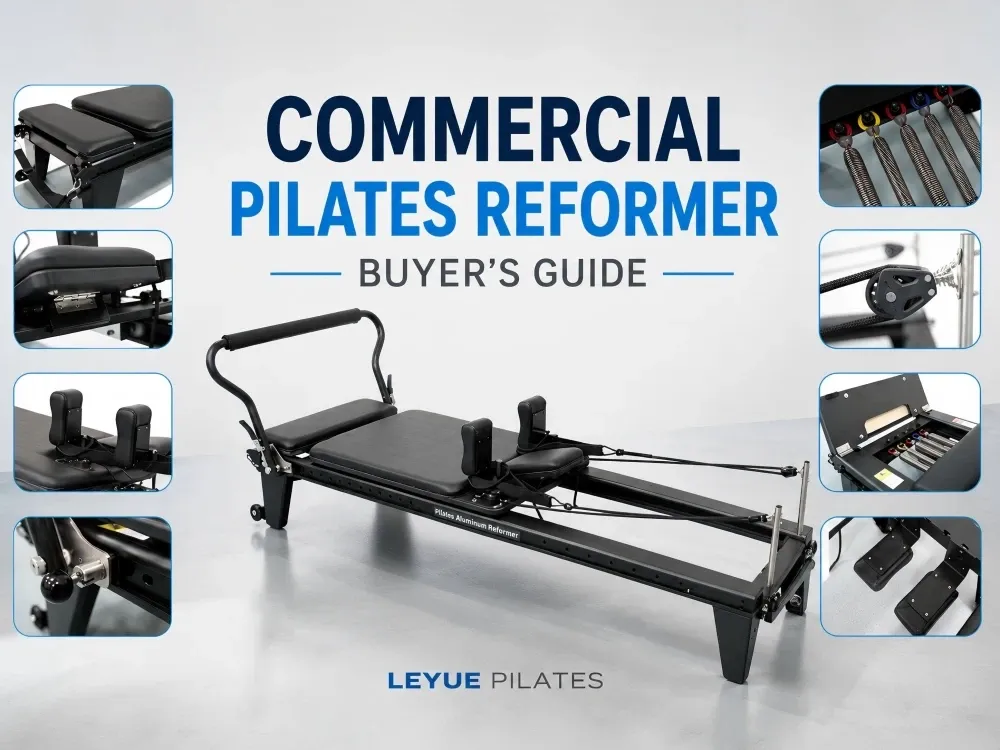
Buying a Pilates reformer for occasional home workouts and purchasing 10, 12 or 20 reformers for a busy commercial studio are two very different decisions.
In a professional Pilates studio, gym or health club, a reformer may be used for several classes every day. Different clients repeatedly adjust the footbar, springs, ropes and headrest, while the carriage may travel back and forth thousands of times over the equipment's service life.
For commercial buyers, appearance and initial price are therefore only part of the purchasing decision.
Frame stability, carriage movement, adjustment systems, noise, upholstery durability, replacement parts and long-term production consistency can all affect the real operating cost of the equipment.
As Reformer Pilates continues to expand beyond boutique studios into gyms, health clubs and larger fitness facilities, these considerations are becoming increasingly important. We discuss this wider market shift in our Commercial Reformer Pilates Trends for Gyms & Health Clubs guide.
So, what should a professional buyer actually inspect before placing a commercial reformer order?
1. Start With the Expected Usage Frequency
The first question should not be:
“How much does the reformer cost?”
A better question is:
“How frequently will the reformer be used?”
A reformer used several times per week at home operates under very different conditions from one running six or more group classes every day.
Before selecting equipment, commercial buyers should consider:
- Number of classes per day
- Number of operating days per week
- Expected number of users per machine
- Private sessions versus group classes
- Expected equipment lifespan
- Planned number of reformers
For example, a six-machine boutique studio operating several private and small-group sessions each day may have different requirements from a health club installing 18 reformers for continuous group classes.
A reformer designed primarily for occasional home exercise should not automatically be assumed to be suitable for high-frequency commercial operation.
This distinction is especially important because today's Pilates equipment market includes everything from foldable and space-saving reformers to heavy-duty commercial studio systems.
Start with the application first. Choose the machine second.
2. Check the Frame Structure and Overall Stability
The frame is the foundation of a commercial reformer.
During repeated use, the structure should remain stable as the carriage moves and clients perform standing, kneeling, jumping and resistance-based exercises.
Commercial buyers should evaluate:
- Frame material
- Overall structural rigidity
- Frame joints and connections
- Rail alignment
- Footbar mounting points
- Standing platform stability
- Maximum recommended user weight
- Movement or vibration under load
Both aluminum and wooden reformers can be suitable for commercial environments, but they serve different purchasing priorities.
Aluminum Reformers
Aluminum is particularly practical for commercial gyms, health clubs, modern Pilates studios and multi-location projects.
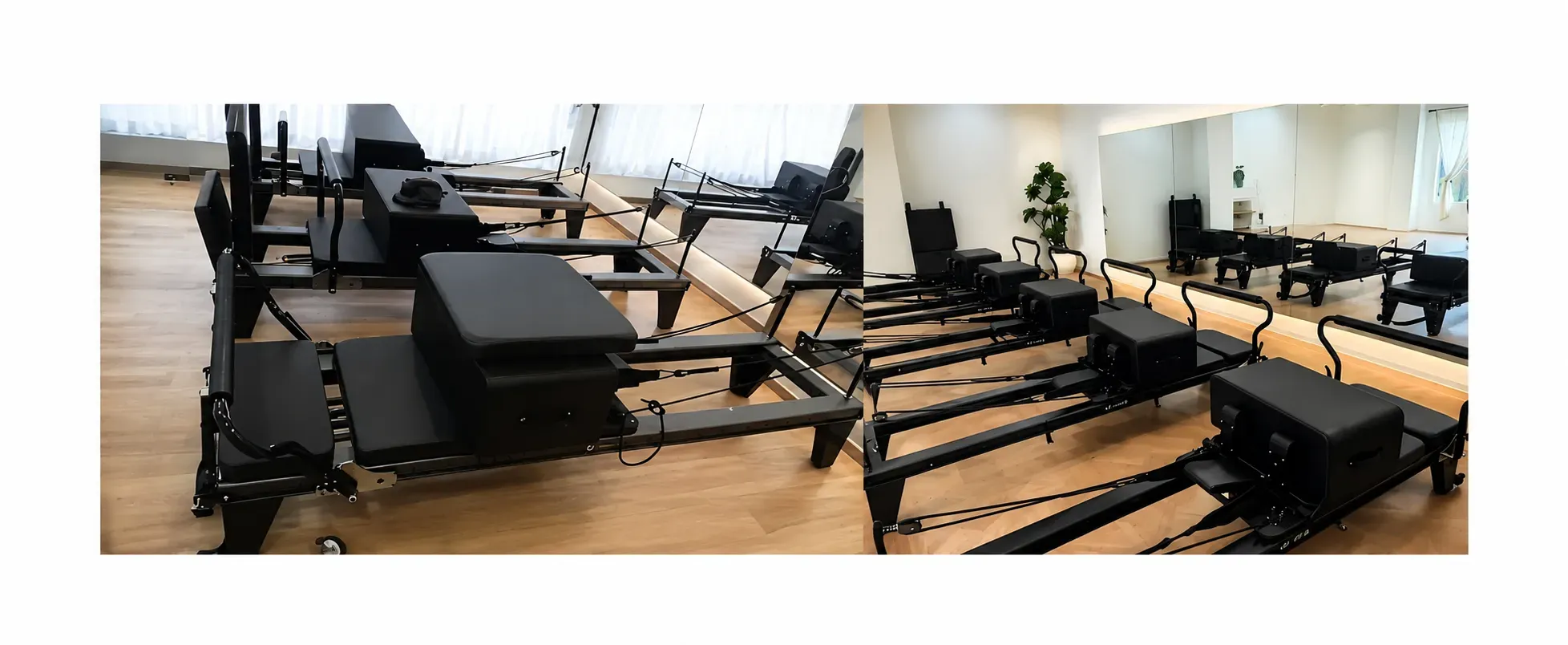
A commercial aluminum frame can offer good dimensional consistency, straightforward cleaning and repeatability across larger production batches.
For example, the Elite A4 Classic Aluminum Pilates Reformer is designed around full-track aluminum construction, commercial studio use and smooth carriage operation.
Wooden Reformers
Wood remains an important option for boutique studios, classical Pilates spaces, hotels and premium wellness environments where equipment appearance forms part of the interior design.
However, buyers should look beyond the wood color and ask about:
- Wood species
- Moisture control
- Frame construction
- Surface finishing
- Structural joints
- Long-term dimensional stability
For premium studio projects, a commercial model such as the Classic Maple Wood Pilates Reformer combines a solid maple structure with a commercial carriage and spring configuration.
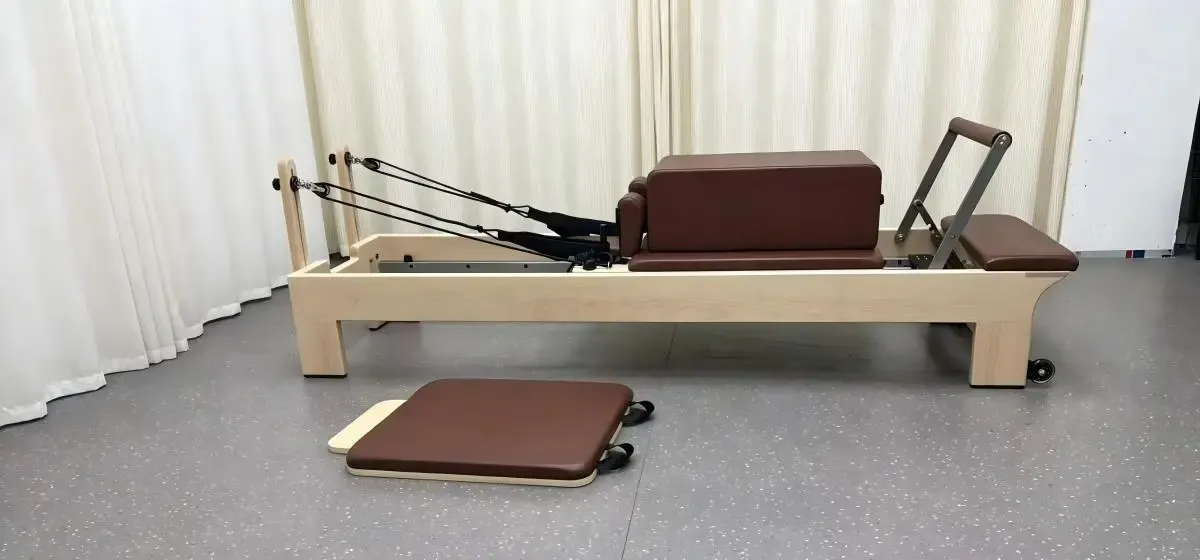
The important point is that frame material alone does not determine reformer quality. The complete structure and component system must be evaluated together.
3. Test the Carriage, Rails and Wheels
One of the most important characteristics of a commercial reformer is also one of the hardest to evaluate from photographs:
How does the carriage actually move?
A polished frame and premium upholstery can make a reformer look impressive online, but the user interacts with the carriage during almost every exercise.
Commercial buyers should evaluate:
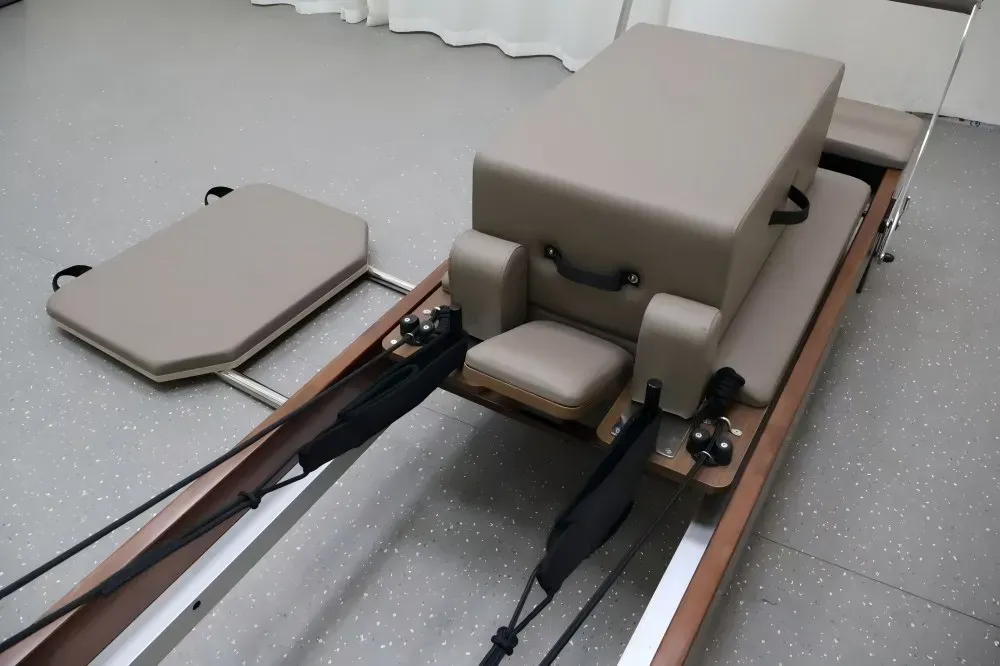
Smoothness
The carriage should travel consistently along the full rail without obvious sticking, sudden resistance changes or uneven movement.
Side-to-Side Stability
Excessive lateral movement can affect both the perceived quality of the machine and the training experience.
Wheel and Bearing Noise
Listen carefully during slow and fast carriage movement.
Rail Alignment
Poor alignment can create uneven wheel wear, friction or noise over time.
Loaded Performance
A reformer can behave differently when nobody is sitting on it.
For this reason, buyers should not evaluate carriage performance only from an unloaded demonstration.
Ask for a Real Operating Video
When purchasing equipment internationally, ask the supplier for an unedited operating video.
Ideally, the video should show:
- Slow carriage movement
- Faster carriage movement
- Full carriage travel
- Movement with a person on the reformer
- Close-up wheel and rail operation
- Natural operating sound
Promotional videos with background music can be useful for understanding appearance, but they are not ideal for evaluating mechanical performance.
4. Evaluate the Spring System Beyond the Number of Springs
A reformer with six springs is not automatically better than one with five.
The number of springs is only one part of the resistance system.
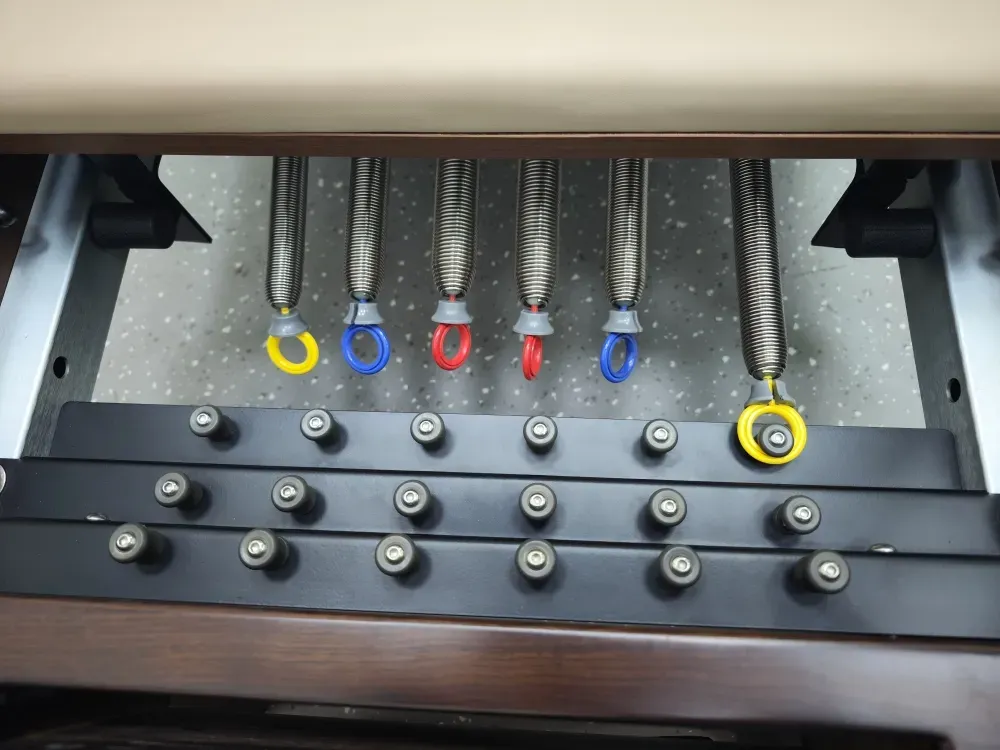
Commercial buyers should also consider:
- Spring material
- Resistance levels
- Resistance consistency
- Surface treatment
- Attachment system
- Fatigue resistance
- Replacement availability
Different Pilates systems may intentionally use different spring configurations, so buyers should choose according to their training style rather than simply comparing spring quantity.
More importantly, think several years ahead.
If one spring eventually needs replacement, can the manufacturer supply the same resistance specification again?
For a commercial studio, long-term spring availability can be more valuable than having an extra spring included in the original package.
5. Inspect the Footbar and Adjustment System
The footbar is one of the most frequently adjusted parts of a commercial reformer.
In group classes, users of different heights may use the same machine throughout the day. Instructors need to make adjustments quickly without interrupting the class.
Buyers should inspect:
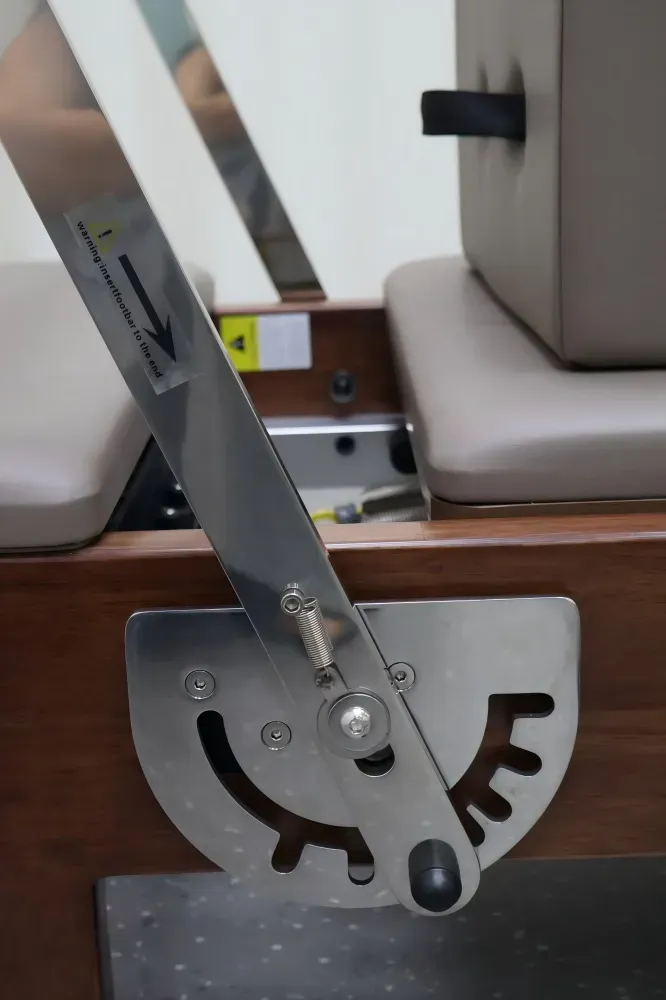
- Number of useful positions
- Adjustment speed
- Locking mechanism
- Side-to-side stability
- Footbar padding
- Mounting structure
- Noise during adjustment
- Ease of use between clients
Some professional reformers also use movable footbars that provide greater positioning flexibility.
For studios that require this type of configuration, the Elite A3 Commercial Aluminum Reformer with Full-Track Movable Footbar is an example of a commercial system built around full-length footbar adjustability.
For high-frequency classes, secure locking and easy adjustment matter more than simply having the highest number of adjustment positions.
6. Check Ropes, Pulleys, Handles and Straps
Smaller components can have a surprisingly large impact on the daily experience of a reformer.
Pay attention to:
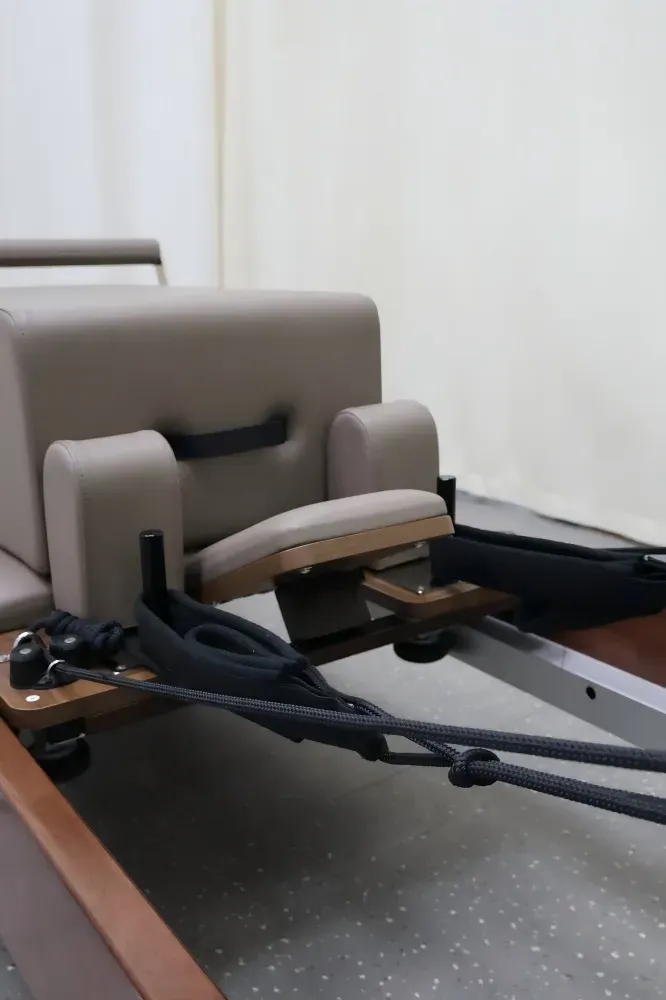
Ropes: Are they resistant to repeated friction and easy to adjust?
Pulleys: Do they rotate smoothly and quietly?
Handles and loops: Are the stitching, padding and attachment points suitable for repeated commercial use?
Straps: Can they be replaced separately if they become worn?
These parts should be treated as part of the equipment's long-term maintenance system rather than as simple accessories.
A good question for a supplier is:
“If we need a replacement rope, pulley or strap two years from now, can you supply the same component?”
Leyue currently also maintains a dedicated Reformer Accessories and Replacement Parts collection, including replacement ropes, straps and other reformer components.
7. Upholstery Matters More in a Commercial Studio
Upholstery is sometimes selected primarily by color.
For commercial buyers, that is only the beginning.
A studio reformer may be exposed every day to:
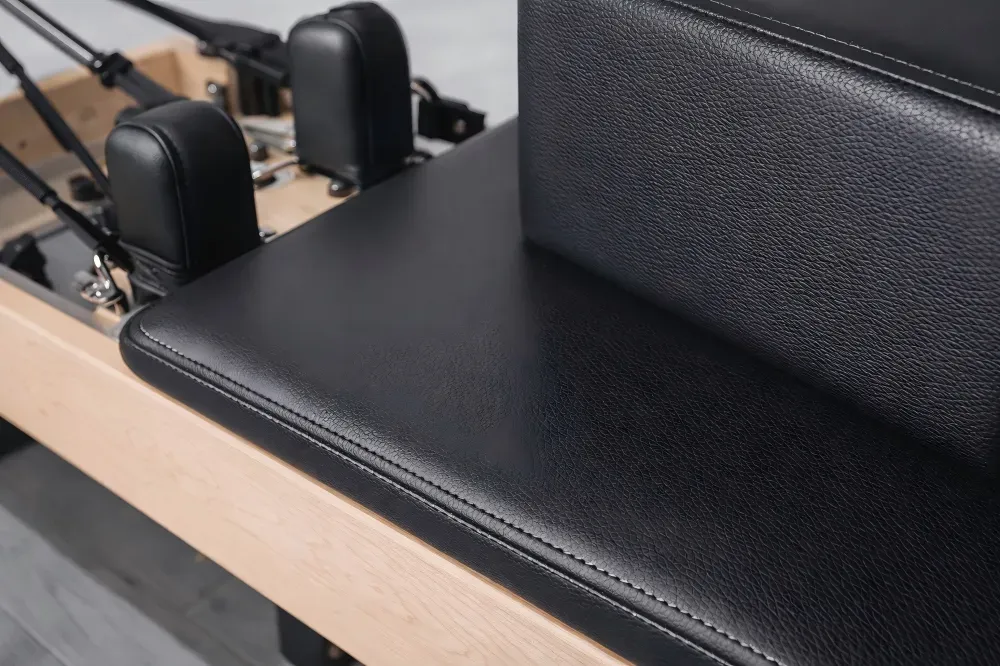
- Repeated friction
- Sweat
- Cleaning products
- Clothing zippers
- Frequent mounting and dismounting
- Different user weights
Buyers should evaluate:
- Abrasion resistance
- Surface cleaning
- Stitching
- Foam density
- Foam recovery
- Long-term deformation
- Upholstery replacement options
For multi-machine projects, another issue becomes important:
Color Consistency
If you purchase 12 beige reformers today and another 12 for a second location next year, can the supplier reproduce the same upholstery specification?
This is particularly important for franchise studios and growing multi-location brands.
A custom color is valuable.
A repeatable custom color is much more valuable.
8. Noise Is a Commercial Buying Factor
Pilates studios are generally quieter environments than conventional gyms.
Clients can hear the carriage, springs, ropes and pulleys moving during a session.
Excessive mechanical noise can therefore affect the perceived quality of the equipment.
Common sources of noise include:
- Carriage wheels
- Bearings
- Rail friction
- Springs
- Pulleys
- Footbar movement
- Loose hardware
- Structural vibration
This is why a real noise test should be part of the supplier evaluation process.
Ask for a video without:
Background music.
Voice-over.
Heavy editing.
Listen to the reformer during:
Slow movement.
Fast movement.
Loaded movement.
Spring return.
Footbar adjustment.
For a studio buying 10 or 20 machines, this simple test can reveal more than dozens of product photographs.
9. Look at Maintenance Before You Buy
A commercial reformer should not be evaluated only on delivery day.
Think about how it will be maintained after:
6 months.
2 years.
5 years.
Ask the manufacturer:
- How should rails and wheels be inspected?
- Which parts require routine maintenance?
- Can individual wheels be replaced?
- Are springs replaceable separately?
- Can ropes and straps be ordered individually?
- Can damaged upholstery be replaced?
- Are maintenance instructions available?
- Can the supplier help identify parts remotely?
This leads to an important purchasing principle:
The real cost of a commercial reformer is not only the purchase price. It is the cost of keeping the equipment operating reliably over its commercial life.
A slightly cheaper machine can become expensive if a small worn component takes several weeks to replace.
10. Confirm Spare Parts Availability Before Ordering
Do not wait until the first machine goes offline to discuss spare parts.
Commercial buyers should confirm availability for components such as:
- Springs
- Carriage wheels
- Ropes
- Pulleys
- Handles and straps
- Shoulder rests
- Footbar components
- Common bolts and hardware
- Upholstery components
For larger installations, consider purchasing a small spare-parts kit with the original equipment shipment.
For example, a studio ordering 12–20 reformers may benefit from keeping selected springs, ropes, wheels and common wear components on site.
This is particularly useful for international projects.
Express shipping one small replacement component across the world can sometimes cost more than the part itself.
A simple rule is:
Plan spare parts when you buy the equipment—not when the first problem occurs.
11. Check Production Consistency for Multi-Unit Orders
Buying one reformer is relatively simple.
Buying 20 identical reformers introduces another requirement:
Production consistency.
Commercial buyers should compare:
- Frame dimensions
- Rail alignment
- Carriage height
- Upholstery color
- Spring resistance
- Footbar position
- Accessory specifications
- Logo placement
- Surface finishing
This becomes even more important when the customer operates multiple locations.
Imagine opening the first studio with 12 machines and opening the second location 18 months later.
Can the manufacturer reproduce the original specification?
For OEM and private-label projects, maintaining production records for colors, logos, configurations and accessories can make repeat orders much easier.
Leyue provides OEM and Private Label Pilates Equipment services for studios, distributors and equipment brands requiring customized and repeatable product configurations.
12. Consider Packaging and International Shipping
For international buyers, the reformer's factory price is not the final cost.
Pilates reformers are relatively large pieces of fitness equipment, so packaging can significantly affect shipping costs.

Before ordering, ask for:
- Packing dimensions
- Gross weight
- CBM per unit
- Packaging material
- Wooden crate requirements
- Container loading quantity
- LCL or FCL recommendation
- Loading and unloading requirements
This is particularly important when comparing suppliers.
Imagine:
Supplier A: Reformer price = $50 cheaper
but
Supplier A: Packaging volume = significantly larger
For an order of 20 machines, the apparent product saving can quickly disappear through additional freight.
The correct comparison is therefore not simply:
EXW price vs. EXW price.
It is:
Landed cost vs. landed cost.
For complete studio projects, buyers can also compare Leyue's Commercial Pilates Reformer Packages for Studios, which are structured around multi-machine studio purchasing and international project supply.
13. Compare Total Cost of Ownership, Not Just Unit Price
Suppose you receive three quotations for commercial reformers.
It can be tempting to sort the spreadsheet by unit price and select the lowest figure.
But a professional comparison should consider:
Equipment Price
-
International Freight
-
Import Costs
-
Expected Maintenance
-
Replacement Parts
-
Potential Downtime
-
Expected Service Life
This is the Total Cost of Ownership.
A reformer that costs slightly more initially may deliver better commercial value if it provides stable performance, easier maintenance and reliable parts availability over several years.
For studios operating fully booked classes, downtime also has a financial cost.
If one machine is unavailable in a 12-reformer class, the issue is not only the cost of the replacement component.
The studio temporarily loses one revenue-producing position.
14. Commercial Pilates Reformer Buyer Checklist
Before approving an order, use this checklist:
What to Check | Why It Matters |
|---|---|
Intended usage | Confirms suitability for commercial operation |
Frame stability | Supports repeated high-frequency use |
Carriage movement | Directly affects training experience |
Rails & wheels | Influence smoothness, wear and noise |
Spring system | Determines resistance consistency |
Footbar locking | Important for adjustment and stability |
Rope & pulley system | Used continuously during classes |
Upholstery & foam | Affect hygiene, appearance and longevity |
Operating noise | Important in premium studio environments |
Spare parts | Helps minimize equipment downtime |
Maintenance | Affects long-term operating cost |
Production consistency | Essential for multi-unit orders |
Repeat-order capability | Important for expanding studios |
Packing dimensions | Directly affect international freight |
Warranty | Clarifies long-term supplier responsibility |
15. Questions to Ask a Pilates Reformer Manufacturer Before Ordering
Before placing a commercial order, ask your supplier these questions:
- Is this reformer specifically suitable for high-frequency commercial use?
- What materials are used for the frame, carriage, rails and upholstery?
- Can you provide an unedited operating and noise-test video?
- What spring specifications and resistance levels are used?
- How is the footbar adjusted and locked?
- Which components normally require maintenance or replacement?
- Can springs, wheels, ropes, pulleys and straps be ordered separately?
- What warranty applies specifically to commercial studio use?
- Can the same configuration be reproduced for future repeat orders?
- What are the packing dimensions, gross weight and CBM per machine?
- How many units can be loaded into a container?
- What OEM colors, logos and private-label options are available?
- Can spare parts be included with the initial shipment?
- Which shipping terms are available—EXW, FOB, CIF or DDP?
A professional manufacturer should be able to discuss more than the machine's appearance and price.
They should also understand how the equipment will be used, maintained, shipped and supported.
16. Choose the Reformer According to Your Business Model
There is no single “best commercial reformer” for every buyer.
The right choice depends on the business model.
Boutique Pilates Studio
Priorities may include:
Smooth movement + quiet operation + design + customization
High-Traffic Commercial Studio
Priorities may shift toward:
Durability + easy adjustment + maintenance + spare parts
Gym or Health Club
The focus may be:
Standardization + high-frequency use + easy cleaning + multi-machine consistency
Luxury Hotel or Wellness Club
The equipment may need:
Premium materials + quiet operation + interior compatibility
Franchise or Multi-Location Operator
The most important factors may become:
Repeatability + standardized components + long-term supply + branding consistency
Distributor or Private-Label Brand
The buyer may need several product levels:
Home + commercial + premium + specialized equipment
Understanding the business model first makes it much easier to choose the correct frame, configuration and price level.
Conclusion: Choose for Long-Term Commercial Use, Not Just the Initial Purchase
Choosing a commercial Pilates reformer should not be reduced to comparing product photographs, spring quantities or unit prices.
For equipment that will operate repeatedly in a professional environment, the more important questions are:
Is the frame stable?
Does the carriage move smoothly and quietly?
Are adjustments easy and secure?
Can wear components be replaced?
Will spare parts still be available later?
Can the same specification be reproduced when the studio expands?
Is the packaging efficient enough for international shipping?
A good commercial reformer should support the studio not only on opening day, but throughout years of daily operation.
For buyers evaluating different commercial equipment options, Leyue Pilates manufactures commercial Pilates equipment for studios and professional projects, including aluminum and wooden reformers, tower systems, studio packages and replacement components.
Planning a Commercial Pilates Project?
Whether you are opening a boutique Pilates studio, adding Reformer Pilates to a gym, developing a multi-location concept or sourcing equipment for distribution, the equipment configuration should match the way the business will actually operate.
When requesting a quotation, send us:
- Required reformer quantity
- Studio or business type
- Preferred frame material
- Expected daily usage
- Custom color requirements
- Logo or private-label requirements
- Required accessories
- Destination country and delivery address
- Target opening date
Leyue Pilates can help evaluate suitable equipment configurations, OEM options, spare parts, packing requirements and international shipping solutions for commercial projects.