
Sep 5, 2026Product Knowledge & Guides
How to Source OEM Pilates Equipment for Your Own Brand: A Private Label Guide
Learn how to source OEM and private label Pilates equipment, from product selection and samples to customization, quality control, spare parts and bulk orders.
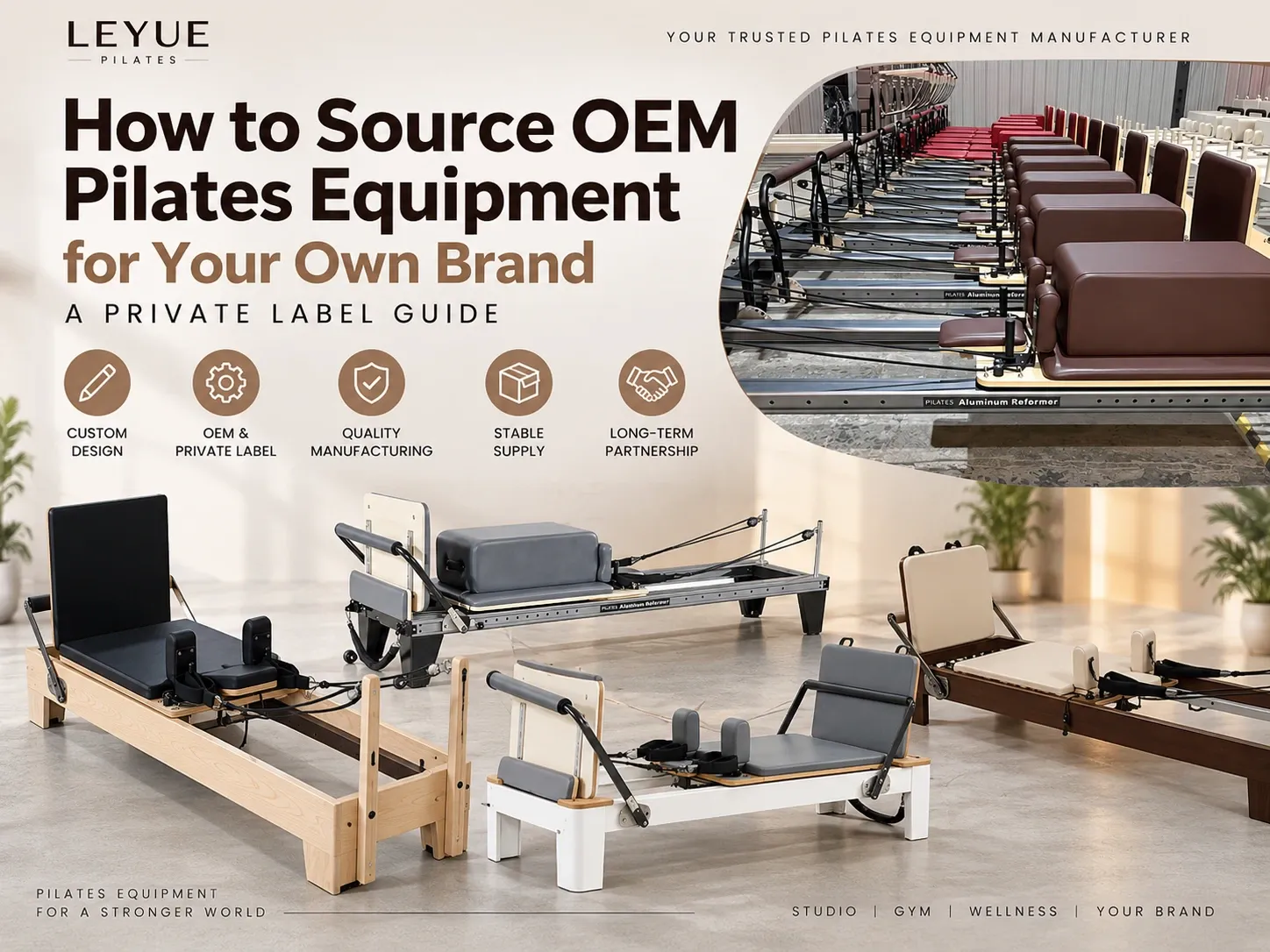
The global growth of Pilates is creating opportunities not only for studios, but also for fitness equipment distributors, importers and brands looking to develop their own Pilates equipment lines.
For these buyers, sourcing Pilates equipment is very different from purchasing several Reformers for a single studio.
You are not simply buying a machine.
You are building a product that may carry your brand for years.
The Reformer you approve today may become a product you reorder several times a year. Your customers may expect replacement springs, wheels and ropes years after the original purchase. As your business grows, you may also want to add Chairs, Cadillacs, Towers, Barrels and other Pilates apparatus while maintaining the same brand identity.
This is why selecting the right OEM Pilates equipment manufacturer requires more than comparing quotations.
Product positioning, manufacturing capability, customization, quality control, batch consistency, spare parts and long-term supply should all be evaluated before building a private-label Pilates equipment line.
This guide explains what distributors, importers and fitness brands should consider before sourcing OEM and private label Pilates equipment.
What Is OEM and Private Label Pilates Equipment?
Although the terms are often used together, OEM and private label projects can involve different levels of customization.
Private Label Pilates Equipment
Private labeling usually begins with an existing manufacturer's product.
The buyer selects an established Reformer or Pilates apparatus and adds brand-specific elements such as:
- Logo
- Upholstery color
- Frame finish
- Wood finish
- Straps
- Packaging
- Product labels
- Manuals
This approach is often suitable for distributors or emerging Pilates brands because the basic equipment design has already been developed.
It can reduce product development time and allow the buyer to enter the market more quickly.
OEM Pilates Equipment
OEM projects can involve deeper customization.
Depending on the project, this may include changes to:
- Frame dimensions
- Aluminum profiles
- Wood construction
- Rail systems
- Footbar designs
- Spring configurations
- Carriage dimensions
- Upholstery specifications
- Hardware
- Accessories
- Packaging
For established distributors and fitness brands, OEM development provides greater control over product positioning and differentiation.
However, deeper customization also requires clearer specifications, sample approval and stronger communication between the buyer and manufacturer.
For an overview of available customization options, explore Leyue Pilates' OEM & Private Label Pilates Equipment solutions.
1. Start With Your Market, Not the Product Catalogue
One of the most common sourcing mistakes is opening a manufacturer's catalogue and asking:
“Which Reformer is your best seller?”
A better question is:
“Which Reformer fits my target customer?”
Before selecting products, define who you plan to sell to.
Your customers might be:
- Boutique Pilates studios
- Large commercial studios
- Home users
- Gyms and health clubs
- Hotels and wellness centers
- Physiotherapy facilities
- Classical Pilates studios
- Fitness equipment retailers
Each segment has different priorities.
A boutique studio may care strongly about appearance and upholstery colors.
A commercial studio may prioritize durability, smooth carriage movement and replacement parts.
A home customer may care more about compact dimensions, foldability and price.
A Classical Pilates studio may require a completely different apparatus system.
Your product line should therefore begin with your market positioning, not with the number of models available from the factory.
2. Do Not Launch Too Many Models at the Beginning
A manufacturer may offer dozens of Reformers, but that does not mean your first product line needs dozens of SKUs.
For many new distributors and private-label brands, a focused range is easier to manage.
A practical starting structure could be:
Entry Level
A compact or foldable Reformer for home and light-use customers.
Core Commercial Model
A professional wooden or aluminum Reformer suitable for Pilates studios.
Premium Model
A higher-specification Reformer with upgraded materials, finishes or configuration.
This creates a simple:
Good → Better → Premium
product structure.
Once these core products are established, the range can gradually expand into:
- Reformer with Tower
- Cadillac
- Pilates Chair
- Ladder Barrel
- Spine Corrector
- Classical Pilates apparatus
- Studio accessories
This approach reduces inventory complexity while allowing your brand to cover different price points.
For buyers planning complete studio projects rather than individual machines, our Commercial Pilates Reformer Packages for Studios provide a useful reference for building equipment combinations.
3. Choose the Right Reformer Platform
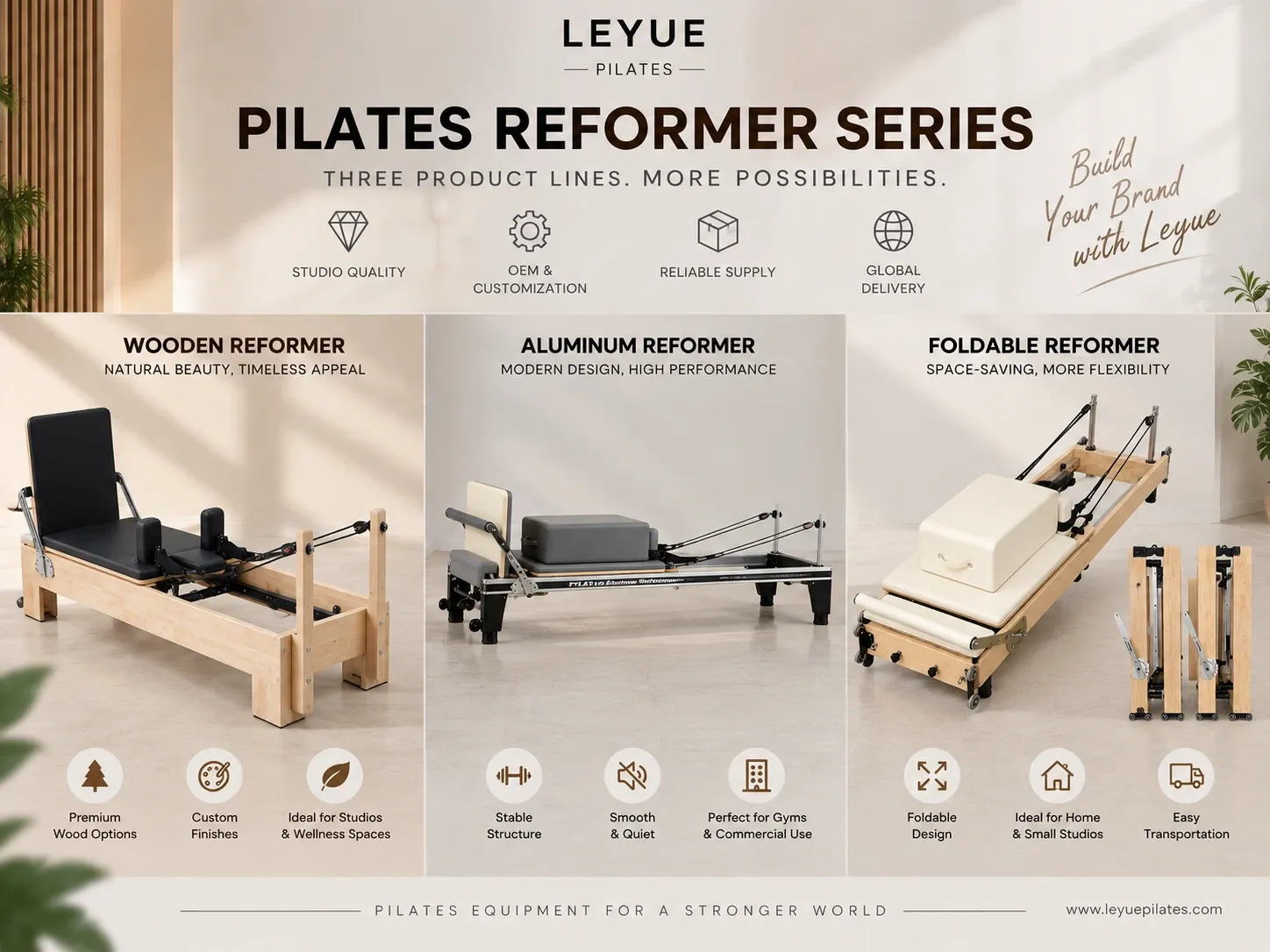
The Reformer will usually be the foundation of a Pilates equipment range.
One of the first decisions is the frame platform.
Wooden Reformers
Wooden Reformers remain popular with boutique studios and premium wellness environments.
Depending on the model and positioning, common options may include:
- Maple
- Beech
- Oak
- Walnut appearance or walnut construction
Wood can provide a warmer, more traditional aesthetic and works particularly well for studios where equipment is part of the interior design.
Aluminum Reformers
Aluminum Reformers are widely used in modern commercial studios.
They can provide a clean, contemporary appearance and are suitable for standardized commercial equipment programs.
Frame finishes and upholstery can also be customized to create different brand identities.
Foldable Reformers
For brands targeting home fitness or customers with limited space, foldable Reformers can create a separate retail category.
The requirements are different from commercial studio equipment.
Packaging dimensions, assembly, storage, weight and shipping costs become especially important because these products may eventually be sold individually to consumers.
The objective is not to determine which frame type is universally “best.”
It is to select the platform that fits your customers, target retail price and brand positioning.
4. Decide What Should Actually Be Customized
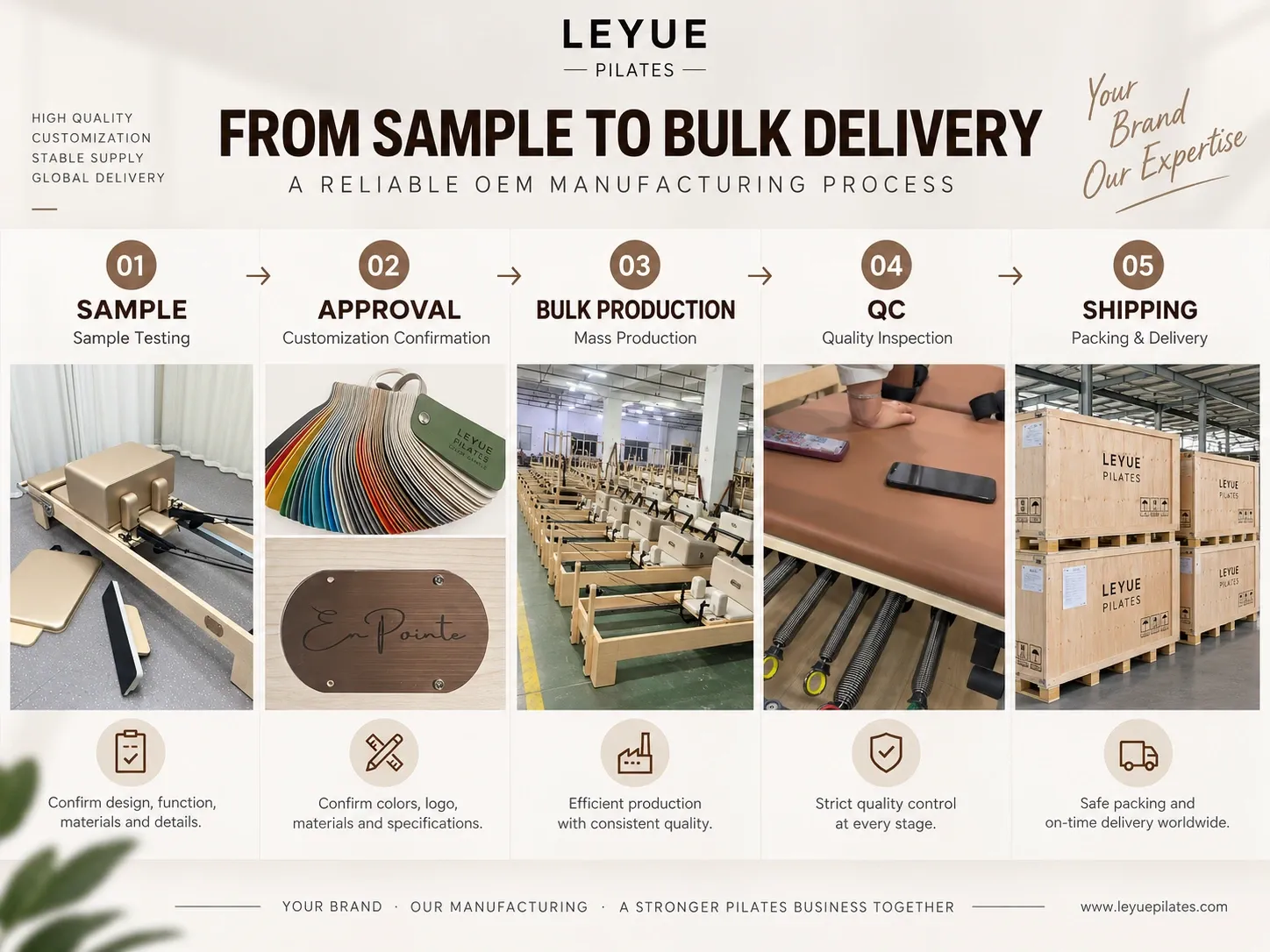
Customization can help differentiate a Pilates brand, but not every component needs to be redesigned.
In many cases, the most commercially useful customization involves the elements customers can see and recognize.
Upholstery
Upholstery is one of the easiest ways to create a recognizable product range.
Possible considerations include:
- Color
- Surface texture
- Wear resistance
- Cleaning requirements
- Stitching
- Foam density
Neutral colors such as black, beige, cream, brown and grey remain common for commercial projects, while private-label brands may develop their own color palette.
Frame Finish
Depending on the equipment, buyers may customize:
- Aluminum frame color
- Wood stain
- Wood finish
- Surface texture
This can help multiple products share the same visual identity.
Logo
Branding can potentially be applied through methods such as:
- Laser engraving
- Metal logo plates
- Upholstery embossing
- Printed branding
- Customized hardware
Logo size and position should be confirmed during sample development rather than decided only during mass production.
Accessories
Straps, handles, ropes and selected accessories can also be coordinated with the main equipment.
For a distributor, the goal should be to create a coherent product family, not simply a machine with a logo attached.
5. Request Clear Specifications Before Comparing Prices
Two Reformers can look nearly identical in photos while having very different specifications.
This is why professional B2B sourcing should not rely only on appearance and unit price.
Before comparing suppliers, request specifications for the major components.
These may include:
- Overall dimensions
- Frame material
- Frame profile
- Rail system
- Carriage construction
- Wheel and bearing configuration
- Spring quantity and resistance
- Footbar design
- Rope system
- Upholstery material
- Foam
- Product weight
- Maximum recommended user weight
- Packing dimensions
- Gross weight
- Included accessories
This creates a much more meaningful basis for comparison.
A lower quotation is not necessarily less expensive if the product uses a different specification.
6. Always Evaluate a Sample Before a Serious Bulk Program
For a distributor or private-label brand, a sample is not simply one machine.
It is your reference standard for future production.
The sample gives you an opportunity to evaluate:
- Frame stability
- Carriage movement
- Noise
- Springs
- Footbar adjustment
- Upholstery
- Stitching
- Hardware
- Accessories
- Color
- Logo
- Packaging
- Assembly
It also allows instructors or technical staff to use the equipment before a larger purchasing commitment.
Photos and videos are useful during supplier screening, but physical testing provides information that cannot always be evaluated remotely.
If you are evaluating a new supplier, learn more about ordering a Pilates Reformer sample before buying in bulk, including what buyers should check before approving mass production:
Once the sample is approved, its specification should become the reference for the bulk order.
7. Treat the Approved Sample as a Product Standard
After sample approval, avoid relying only on messages such as:
“Please make the bulk order the same as the sample.”
For long-term OEM programs, the approved configuration should be documented.
Depending on the project, this may include:
- Model number
- Revision number
- Frame specification
- Upholstery code
- Spring configuration
- Hardware
- Logo dimensions and position
- Accessories
- Packaging
- Approved photos
- Special requirements
This becomes particularly important when orders are repeated months later.
A distributor may approve one model today and reorder it three or four times over the next two years.
Without clear specifications, small uncontrolled changes can gradually appear between production runs.
This becomes especially important for repeat orders. Read more about batch-to-batch consistency in Pilates equipment manufacturing and why the approved sample should become the reference standard for future production.
8. Evaluate the Manufacturer, Not Only the Finished Reformer
A good sample is important.
But for an importer or distributor, the bigger question is:
Can the manufacturer reproduce it consistently at scale?
When evaluating an OEM Pilates equipment manufacturer, consider the production process behind the finished machine.
Relevant areas may include:
Material Control
How are wood, aluminum profiles, springs, upholstery, wheels and hardware specified?
Frame Production
How are dimensions, drilling positions, welding points and alignment controlled?
Assembly
How are rails, carriages, footbars, ropes and springs installed and checked?
Upholstery
Can the supplier maintain similar color, foam and stitching specifications between production batches?
Quality Inspection
Is the equipment tested before packing?
Packing
Is packaging suitable for international transportation?
These questions become increasingly important as order quantities grow.
A buyer ordering one machine can solve an individual problem relatively easily.
A distributor importing 50 machines cannot manage every unit individually.
The manufacturing process needs to create consistency.
9. Batch Consistency Is Critical for Private-Label Brands
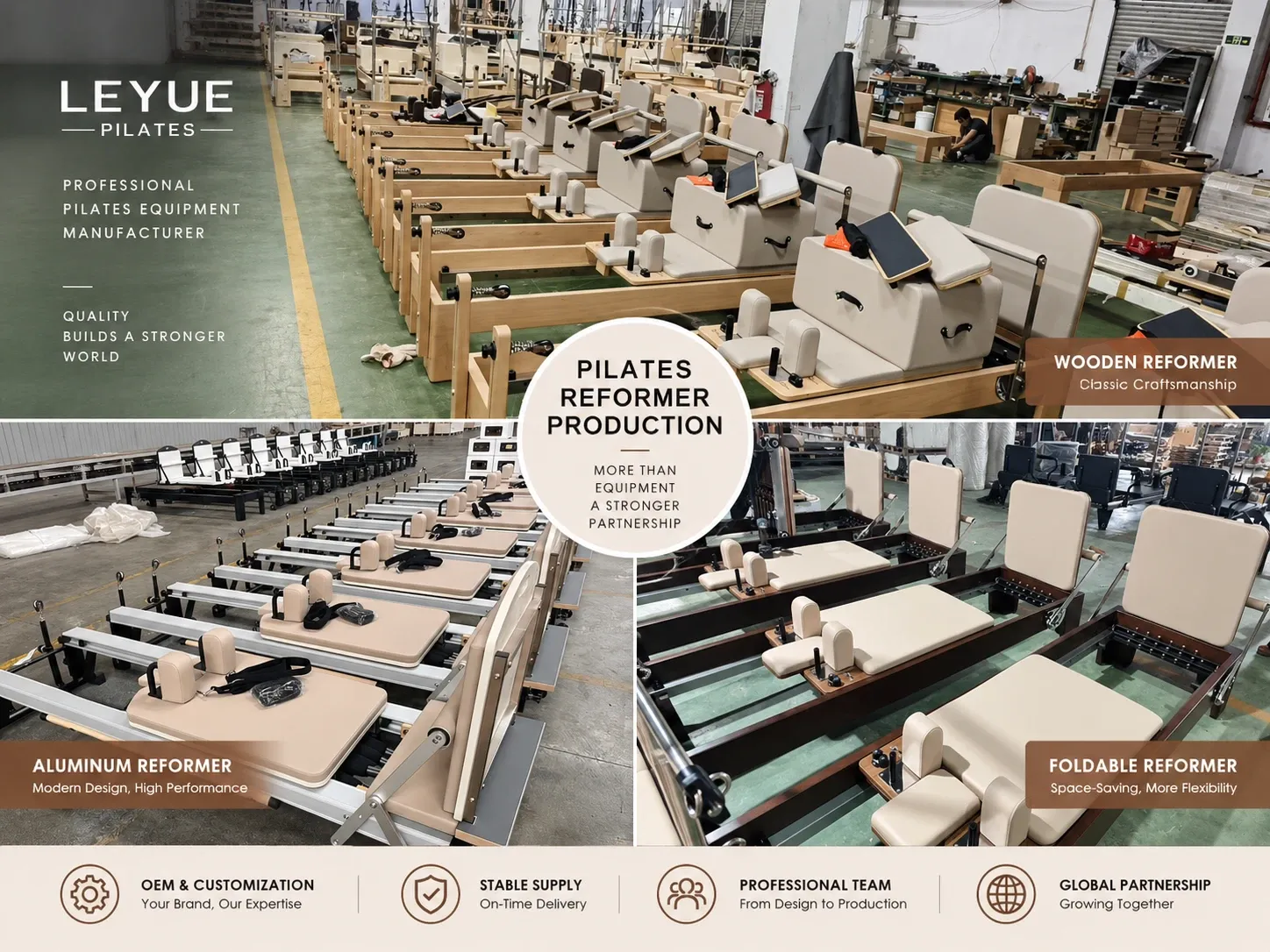
Imagine you import 20 Reformers for your first order.
They sell well.
Six months later, you order another 40.
Your customers expect the second shipment to represent the same product.
Problems arise if the new batch has noticeably different:
- Upholstery
- Springs
- Wheels
- Footbar positions
- Rope lengths
- Frame finish
- Accessories
For the end customer, this is not the manufacturer's product.
It is your brand's product.
That means supplier consistency directly affects your reputation.
Product improvements are not necessarily a problem. Components and designs can improve over time.
The important issue is that significant changes should be controlled, documented and communicated when necessary.
10. Spare Parts Should Be Planned Before the First Bulk Order
After-sales support begins before the first container leaves the factory.
Pilates equipment contains wear components.
Depending on use, these may eventually include:
- Springs
- Wheels
- Bearings
- Ropes
- Straps
- Handles
- Pulleys
- Upholstery components
- Footbar hardware
- Small fasteners
For distributors, spare parts are especially important because your customers will contact you when something needs replacement.
Before placing a bulk order, discuss:
- Which parts are considered wear items?
- Which spare parts should be included with the shipment?
- Can replacement components be ordered individually?
- Will future parts remain compatible?
- How are parts identified?
A small spare-parts inventory can often solve after-sales issues much faster than sending components internationally every time a customer needs assistance.
11. Think About Packaging as Part of Product Development
Packaging is sometimes treated as the final step.
For an importer, it should be considered much earlier.
Packing affects:
- Product protection
- Shipping volume
- Container loading
- Warehouse handling
- Local delivery
- Customer experience
- Final landed cost
This is especially important for large Pilates apparatus.
A small reduction in packaging volume multiplied across 20, 40 or 80 machines can affect container utilization and freight cost.
For private-label retail products, packaging may also need:
- Brand logo
- Product information
- Model number
- Handling instructions
- Assembly information
- Labels
Therefore, packaging should be included in the product specification rather than treated as an afterthought.
12. Calculate Landed Cost, Not Just Factory Price
The lowest EXW or FOB price does not automatically create the lowest final cost.
International buyers should evaluate the complete landed-cost structure.
Depending on the trade terms, this may include:
**Product cost
- Packaging
- Inland transportation
- Export charges
- Ocean or air freight
- Import duty
- Customs clearance
- Local delivery
- Warehouse handling**
Packing dimensions are particularly important for Pilates equipment because the products are relatively bulky.
When comparing two Reformers with similar factory prices, the model with more efficient packaging may ultimately provide a better landed cost.
This becomes increasingly important for container orders.
13. Plan Your First Bulk Order Carefully
After the sample has been approved, the first commercial order should confirm whether the complete supply process works as expected.
For a new private-label program, the first order does not always need to be the largest possible order.
It should be large enough to evaluate:
- Production consistency
- Packaging
- Shipping
- Warehouse handling
- Customer response
- Installation
- After-sales requirements
Once the product performs well in the target market, order quantities can increase.
A typical sourcing path may therefore look like:
Supplier Evaluation
↓
Specification Discussion
↓
Sample
↓
Sample Testing & Revision
↓
Final Specification Approval
↓
First Bulk Order
↓
Market Feedback
↓
Repeat Orders
↓
Product Line Expansion
This approach reduces risk while creating a more stable foundation for long-term cooperation.
14. Expand the Product Line After the Core Reformer Is Established
Once the core Reformer is performing successfully, additional Pilates apparatus can be introduced.
A distributor may gradually expand into:
Reformer with Tower
Useful for studios looking for broader exercise programming within the Reformer footprint.
Pilates Chairs
Compact equipment that can complement Reformer sales and complete studio projects.
Cadillac / Trapeze Table
Suitable for professional Pilates studios and complete apparatus programs.
Ladder Barrel and Spine Corrector
Useful additions for studios building a broader Pilates equipment environment.
Classical Pilates Equipment
Classical Reformers, Wunda Chairs, Baby Chairs, Pedi Poles and other apparatus can help distributors serve professional Classical Pilates studios and instructor training centers.
Accessories and Props
Mats, rings, balls, resistance bands, dumbbells and other studio accessories can support one-stop purchasing.
Leyue Pilates' commercial studio equipment packages provide examples of how Reformers and complementary apparatus can be combined for different project sizes.
15. When Should You Consider Custom Product Development?
Not every private-label buyer needs a completely new Reformer.
In many cases, adapting an existing proven platform is faster and more economical.
More extensive product development makes sense when you have identified a clear market requirement.
Examples might include:
- Different frame dimensions
- A specific footbar mechanism
- A unique color system
- A different spring configuration
- Space-saving requirements
- Special accessories
- A distinctive product appearance
The key question should always be:
Does this modification create real value for the target customer?
Customization for the sake of being different can add cost and complexity without improving the product's commercial potential.
The strongest OEM projects usually begin with a clear market need.
16. Build a Supplier Relationship That Can Grow With Your Brand
For a private-label Pilates brand, the ideal manufacturing relationship extends beyond the first purchase order.
As the business develops, you may need:
- New product development
- Additional colors
- Updated packaging
- Larger production volumes
- New markets
- Additional certifications
- Replacement parts
- Product improvements
- New apparatus categories
This is why long-term B2B sourcing should focus on more than price negotiation.
Communication, documentation, production stability and after-sales support all become increasingly valuable over time.
A reliable manufacturing partner should understand not only how to build the equipment, but also how repeat B2B supply works.
OEM & Private Label Pilates Equipment with Leyue Pilates
Leyue Pilates works with Pilates studios, distributors, importers and fitness brands on commercial Pilates equipment and OEM/ODM projects.
Our product range includes:
- Wooden Pilates Reformers
- Aluminum Pilates Reformers
- Foldable Reformers
- Reformers with Towers
- Cadillac / Trapeze Tables
- Pilates Chairs
- Ladder Barrels
- Spine Correctors
- Classical Pilates equipment
- Studio accessories
Depending on the product and project requirements, customization can include upholstery, frame finishes, wood finishes, equipment configuration, logo branding and packaging.
Our goal is not simply to supply the first order.
For B2B customers, we focus on supporting repeat purchasing through documented specifications, quality control, replacement parts and long-term product supply.
You can explore our OEM & Private Label Pilates Equipment solutions to learn more about available materials, product configurations and customization options.
For real project applications, visit our Pilates Equipment Case Studies.
If you are building a complete studio or supplying studio customers, you can also explore our Commercial Pilates Reformer Packages for Studios.
Planning Your Own Pilates Equipment Line?
If you are a distributor, importer, fitness equipment company or Pilates brand planning your own equipment range, start with four pieces of information:
1. Your target market
Who will use or purchase the equipment?
2. Your preferred product category
Home, commercial studio, premium, Classical Pilates or a combination?
3. Estimated order quantity
This helps determine suitable customization and production options.
4. Destination market
Shipping, packaging and product requirements can vary by country.
With these details, an OEM Pilates equipment manufacturer can recommend a much more appropriate product and sourcing solution.
If you are developing a new Pilates equipment line or looking for an alternative manufacturing partner, explore our OEM & Private Label Pilates Equipment manufacturing services or contact Leyue Pilates with your target products, estimated quantity, destination market and customization requirements.
We can help you evaluate suitable Reformer platforms, customization options, samples and bulk production solutions for your market.